|
|
|
Welcome to the Bananas.org forums. You're currently viewing our message boards as a guest which gives you limited access to participate in discussions and access our other features such as our wiki and photo gallery. By joining our community, you'll have access to post topics, communicate privately with other members (PM), respond to polls, upload photos, and access many other special features. Registration is fast and simple, so please join our community today! If you have any problems with the registration process or your account login, please contact us. |
|
|||||||
| Register | Photo Gallery | Wiki | Map | Today's Posts | Search |
| Other Plants Discussion of all other types of plants besides bananas. |
|
Hey there! It looks like you're enjoying Bananas.org but haven't created an account yet. Why not take a minute to register for your own account now? As a member you get access to all of our forums and posts plus the ability to post your own messages, communicate directly with other members and much more. Register now! Already a member? Login at the top of this page to stop seeing this message. |
 Members currently in the chatroom: 0
|
|
 |
The most chatters online in one day was 17, 09-06-2009. No one is currently using the chat. |

 Email this Page Email this Page
|
|
|
LinkBack | Thread Tools |
 07-19-2009, 02:41 AM
|
#1 (permalink) |
|
Nanner Time!

Location: Cedar Rapids, IA
Zone: 5
Name: Bryan
Join Date: Mar 2009
Posts: 2,937
BananaBucks
: 160,225
Feedback: 0 / 0%
Said "Thanks" 534 Times
Was
Thanked 2,243 Times in 1,245 Posts
Said "Welcome to Bananas" 855 Times
 |
 Colocasia/Alocasia
Okay, so I have to ask (cause you all seem to know this stuff!)....what's the difference between colocasias and alocasias??? I bought an elephant ear that was a colocasia, yet saw plants at the Missouri Botanical Gardens labeled as 'elephant ear alocasia' again and again. I'm just wondering what the difference is! Can anyone dispel my ignorance on this issue please!?!?!?
__________________
  BANANA RAVE! BANANA RAVE!Feel the beat from start to stop, dancin' and movin' from bottom to top! lilraverboi@genxglow.com RIP Tog Tan. We love you and will always remember you! I'm Bryan with a Y! There is no 'I' in BRYAN! |

|


|
| Said thanks: |
 | Are you a banana plant enthusiast? Then we hope you will join the community. You will gain access to post, create threads, private message, upload images, join groups and more. |
|
Sponsors |
|
07-19-2009, 04:52 AM
|
#2 (permalink) |
|
Banned
Join Date: May 2009
Posts: 2,759
BananaBucks
: 184,966
Feedback: 0 / 0%
Said "Thanks" 1,364 Times
Was
Thanked 856 Times in 421 Posts
Said "Welcome to Bananas" 163 Times
|
Re: Colocasia/Alocasia
G'morning, RaverBoi
 . .Toxicity. Each a genus of the family Araceae, while there are 70 species of Alocasia found in Asia, Oceania, & South America, there are only 6 or 8 species of genus Colocasia. The Colocasia are shallow, herbaceous perennials native to Polynesia & Southeastern Asia. While both derive from a rhizome or tuber and appear very similar, reasons for cultivation differ dramatically. ColocasiaThe tubers, & even leaves, are considered a delicacy in European & Indian recipees which are quite diverse & numerous. They are perfectly safe & cultivated as a food source. AlocasiaThe stem (or corm) contains raphid crystals of oxalic acid which can numb and swell the tongue & pharynx. While edible, they are not considered a delicacy and require long duration boiling to remove the toxins. Other symptoms of improper ingestion include pain and hallucinations. Another South American plant, notorious for causing oral swelling, is Dieffenbachia - also of family Araceae (an Aroid). Used in the distillation of Curare - while notably for acts of defense & aggression - the various forms of Curare are also useful in hunting game for food. Lorax (living in Ecuador) is very well versed in both Aroids & that style of hunting. Hope this helps .Last edited by Eric : 07-19-2009 at 05:23 AM. Reason: Incomplete |
|
|
|
| Said thanks: |
|
07-19-2009, 05:41 AM
|
#3 (permalink) |
|
Mark

Location: Windsor u.k.
Name: Mark Hall
Join Date: Oct 2006
Posts: 616
BananaBucks
: 168,421
Feedback: 1 / 100%
Said "Thanks" 385 Times
Was
Thanked 282 Times in 123 Posts
Said "Welcome to Bananas" 15 Times
|
Re: Colocasia/Alocasia
Its usually an easy way to tell the difference. Colocasia leaves usually hang down where as most Alocasia leaves point up.. Thats what I try to go by
Occasionally you get some plants that just hang almost level  I find growing colocasias quite wet helps give you bigger plants. Alocasias dont like the wet too much and they prefer a more free draining open compost for me.
__________________
Time Flies like an Arrow.....Fruit flies like a Banana. 
|
|
|
|
| Said thanks: |
|
07-19-2009, 11:17 AM
|
#4 (permalink) | |
|
Rabid Nanner

Location: Houston, Tx
Zone: 9
Name: Alex
Join Date: Jul 2007
Posts: 559
BananaBucks
: 114,712
Feedback: 0 / 0%
Said "Thanks" 40 Times
Was
Thanked 374 Times in 218 Posts
Said "Welcome to Bananas" 107 Times
|
Re: Colocasia/Alocasia
Quote:
You know I always wandered about that Thanks for the tip.
__________________
 
|
|
|
|
|
|
07-19-2009, 11:21 AM
|
#5 (permalink) |
|
Banned

Location: Ecuador, South America
Zone: USDA 13 / Köppen-Geiger BSh
Name: Lorax
Join Date: Jul 2007
Posts: 2,532
BananaBucks
: 405,175
Feedback: 0 / 0%
Said "Thanks" 742 Times
Was
Thanked 3,040 Times in 1,188 Posts
Said "Welcome to Bananas" 464 Times
|
Re: Colocasia/Alocasia
Colocasia are also normally much larger leaves than Alocasia, and there are fewer interesting colour variations in Colocasia. However, Mark's method of telling them apart becomes difficult when you're faced with the Xanthosoma-type Colocasias, which have non-flexed leaves.
A slightly easier way to tell from the leaves is by their structure. Colocasia tend to have well-defined anterior lobes, although the sinus (where the petiole and the leaf meet) is normally found below a fused portion of the anterior lobes. The petiole (leaf stalk) is normally of equal length to the leaf blade. The leaves of Colocasia also tend to be a great deal larger than those of Alocasia, especially given the cultivars that are normally available as "elephant ears" (a term which I despise, BTW.) Also, with the exception of Colocasia 'Illustris' which is purple, most commonly available plants have green leaves with a VELVET texture, while Alocasia tend to be WAXY and come in a wider array of variegations, often with well defined ribs on the leaves (see Alocasia 'Amazonica' for a good example of this.) However, the easiest way to tell is to look at the tubers. Colocasia have large, swollen, banded tubers with easily visible "eyes" at either end. Alocasia tubers tend to be thinner, longer, and without the visible "eyes." Colocasia (Taro) Tubers 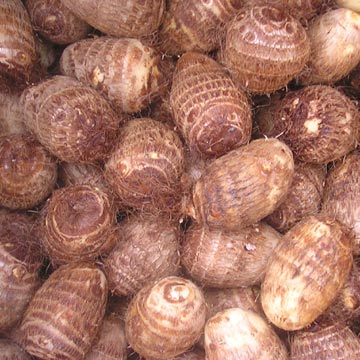 Alocasia Tubers (Macrorrhizhos, botanical illustration)  Last edited by lorax : 07-26-2009 at 11:42 AM. |
|
|
|
| Said thanks: |
|
Sponsors |
|
07-19-2009, 12:16 PM
|
#6 (permalink) | |
|
Nanner Time!
Location: Cedar Rapids, IA
Zone: 5
Name: Bryan
Join Date: Mar 2009
Posts: 2,937
BananaBucks
: 160,225
Feedback: 0 / 0%
Said "Thanks" 534 Times
Was
Thanked 2,243 Times in 1,245 Posts
Said "Welcome to Bananas" 855 Times
|
Re: Colocasia/Alocasia
Quote:
    Woah....you weren't kidding! LOL....j/k j/k. Thanks for all the great information, everyone! I think I got better responses than I was expecting even. You guys/girls ROCK! If anyone else has anything else...please share! I love learning. But thanks again to everyone who has posted already!
__________________
BANANA RAVE!Feel the beat from start to stop, dancin' and movin' from bottom to top! lilraverboi@genxglow.com RIP Tog Tan. We love you and will always remember you! I'm Bryan with a Y! There is no 'I' in BRYAN! |
|
|
|
|
| Said thanks: |
|
07-19-2009, 12:23 PM
|
#7 (permalink) |
|
Banned
Location: Ecuador, South America
Zone: USDA 13 / Köppen-Geiger BSh
Name: Lorax
Join Date: Jul 2007
Posts: 2,532
BananaBucks
: 405,175
Feedback: 0 / 0%
Said "Thanks" 742 Times
Was
Thanked 3,040 Times in 1,188 Posts
Said "Welcome to Bananas" 464 Times
|
Re: Colocasia/Alocasia
To elaborate a little bit on what I was saying earlier, and hopefully make myself a bit clearer:
Colocasia: Petiole about the same length as the leaves or shorter, defined posterior lobes with small fusion towards the sinus, leaf shape more oblate (rounder), petioles are normally coloured (rather than the leaves) and quite stocky, velvet leaf surface, round tubers. Leaf blades often very very large. Leaves normally reflexed (point down), although some species are erect. C. esculenta  Alocasia: Petioles normally longer than leaf blades, well-defined posterior lobes with small fusion towards the sinus, leaf shape more saggitate (arrow shaped), petioles normally green or purple and quite delicate, highly coloured leaves, waxy leaf surface, long tubers. Alocasias are often smaller leaves. Leaves normally reflexed (point down), although some species are erect. Alocasia 'Amazonica'  Ready for the exceptions? Alocasia odora (and A. macrorrhiza, a very similar species) bears HUGE erect leaves with a somewhat velvety-leathery texture, which superficially resembles Colocasias.  Colocasia gigantea is also HUGE erect leaves with a somewhat velvety-leathery texture. The only visual difference between it and A. odora, without digging it up to look at the bulbs, is that there is more fusion of the posterior lobes.  And if you want a real mindbender, Xanthosoma saggitafolium - which is also referred to as an Elephant Ear, is sometimes sold in garden centers, is an edible, but is neither Colocasia nor Alocasia. This has huge reflexed saggitate leaves with a velvety-leathery texture, petioles longer than the leaves and much thicker than those of Alocasia or Colocasia. This is another edible Aroid, native to Ecuador. Xanthosoma are superficially very similar to Colocasia, with the giveaway being a more elongated and much larger tuber, the more leathery texture of the leaves, and the lack of fusion in the posterior lobes of the leaf. The one in the photo, which is a wild specimen, had a leaf blade in excess of 5' from the tip of the posterior lobes to the point of the leaf. 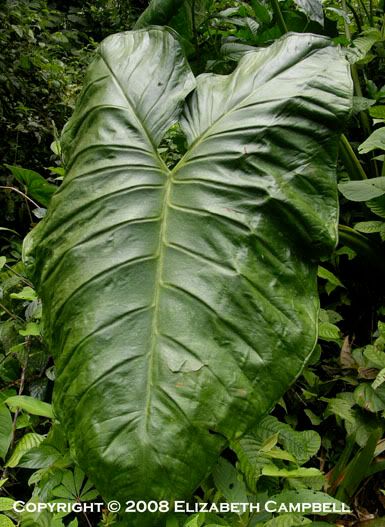 And of course, since we're dealing with members of the Aracea, the bottom line is that all species are VERY variable - so all these handy little guidelines only apply to a portion of the plants of any given species. There are Colocasias with waxy leaves, and Alocasias with a high degree of posterior-lobe fusion, and Xanthosomas may have fine petioles. I can only ID them on sight because I've been doing it for a long time, and even now I still make mistaken IDs and have to check the tubers - I grow examples of all three genera, and forage Xanthosoma and escapee Colocasia in the forests, and I still get them mixed up sometimes. Best of luck! |
|
|
|
| Said thanks: |
|
07-19-2009, 12:34 PM
|
#8 (permalink) |
|
Banned
Location: Ecuador, South America
Zone: USDA 13 / Köppen-Geiger BSh
Name: Lorax
Join Date: Jul 2007
Posts: 2,532
BananaBucks
: 405,175
Feedback: 0 / 0%
Said "Thanks" 742 Times
Was
Thanked 3,040 Times in 1,188 Posts
Said "Welcome to Bananas" 464 Times
|
Re: Colocasia/Alocasia
Oh, and I'm gonna go on a bit of a screed here, because I HATE the term "elephant ear" to describe the big-leaf Aroids.
First of all, the only Elephant Ears I'm aware of belong to the genera Loxodonta and Elephas. I understand the common term to mean "honking big leaves" but at the same time, since "EE" covers: Alocasia, Colocasia, Xanthosoma, Philodendron, Anthurium, and Monstera (phew, got that? Six really large and diverse genera!) it's, shall we say, somewhat less than adequately descriptive of the plants in question. Argh. Thank you for putting up with that, it's something that bugs me. |
|
|
|
| Said thanks: |
|
07-19-2009, 12:45 PM
|
#9 (permalink) |
|
Nanner Time!
Location: Cedar Rapids, IA
Zone: 5
Name: Bryan
Join Date: Mar 2009
Posts: 2,937
BananaBucks
: 160,225
Feedback: 0 / 0%
Said "Thanks" 534 Times
Was
Thanked 2,243 Times in 1,245 Posts
Said "Welcome to Bananas" 855 Times
|
Re: Colocasia/Alocasia
LOL...yeah, so even before the last post, I was getting the idea that the term 'elephant ears' is pretty worthless.
Thanks for the info, Beth! I have a pretty good idea what I'm looking for now. I'll have to try my hand at correct identification next time I'm at the Botanical Gardens!
__________________
BANANA RAVE!Feel the beat from start to stop, dancin' and movin' from bottom to top! lilraverboi@genxglow.com RIP Tog Tan. We love you and will always remember you! I'm Bryan with a Y! There is no 'I' in BRYAN! |
|
|
|
| Said thanks: |
|
07-19-2009, 12:50 PM
|
#10 (permalink) |
|
Banned
Location: Ecuador, South America
Zone: USDA 13 / Köppen-Geiger BSh
Name: Lorax
Join Date: Jul 2007
Posts: 2,532
BananaBucks
: 405,175
Feedback: 0 / 0%
Said "Thanks" 742 Times
Was
Thanked 3,040 Times in 1,188 Posts
Said "Welcome to Bananas" 464 Times
|
Re: Colocasia/Alocasia
Well, shoot, you have easy access to the MOBOT, which is where many of the leading Aroid botanists are. I'm surprised there are tags there saying "elephant ears" given that I know Dr. Croat (one of the world's leading experts on Philodendron and Anthurium) also hates the term. They have some pretty amazing collections of plants from my neck of the woods...
|
|
|
|
|
07-19-2009, 01:00 PM
|
#11 (permalink) |
|
3rd winter growing indoor

Location: Northern Indiana
Zone: 5
Name: Dan
Join Date: Jul 2007
Posts: 877
BananaBucks
: 42,867
Feedback: 4 / 100%
Said "Thanks" 2,437 Times
Was
Thanked 260 Times in 169 Posts
Said "Welcome to Bananas" 342 Times
|
 Re: Colocasia/Alocasia
OK thanks Beth,
 now throw a twist at you were do Caladium fit in now throw a twist at you were do Caladium fit inor are they something totaly different?  Sorry to make this confusing! 
__________________
   
|
|
|
|
| Said thanks: |
|
07-19-2009, 01:01 PM
|
#12 (permalink) | |
|
Banned
Join Date: May 2009
Posts: 2,759
BananaBucks
: 184,966
Feedback: 0 / 0%
Said "Thanks" 1,364 Times
Was
Thanked 856 Times in 421 Posts
Said "Welcome to Bananas" 163 Times
|
Re: Colocasia/Alocasia
Quote:
!!!!!!!!!!!!!!!Last edited by Eric : 07-19-2009 at 04:23 PM. Reason: Typo |
|
|
|
|
|
07-19-2009, 01:50 PM
|
#13 (permalink) |
|
Banned
Location: Ecuador, South America
Zone: USDA 13 / Köppen-Geiger BSh
Name: Lorax
Join Date: Jul 2007
Posts: 2,532
BananaBucks
: 405,175
Feedback: 0 / 0%
Said "Thanks" 742 Times
Was
Thanked 3,040 Times in 1,188 Posts
Said "Welcome to Bananas" 464 Times
|
Re: Colocasia/Alocasia
D&T, Caladium are part of the same tribe as Colocasia, Alocasia, and Xanthosoma.
These are smaller plants with only one or two leaves visible at any one time (up to 5 on newer cultivars, but never that many in the wild), a rhizome more like bananas, and much more variety in the colour their leaves, which are always velvety. Caladium, like Xanthosoma, are native to the New World (ie my neck of the woods), whereas Colocasia and Alocasia are Old World plants. The petioles are often very delicate (in the case of C. clavatum, so much so that they sometimes don't support the leaves) and the leaves are edible when steamed, much like Spinach but with a better flavour. Caladium leaves normally exhibit more posterior-lobe fusion than the other three genera, and they're also (with the exception of C. clavatum) a great deal smaller than the leaves of Colocasia and Xanthosoma. Here are the two variations of Caladium steudnerifolium, which is Ecuadorean; scientists studying it have found that the variegation is a response to insect predation. Solid Form 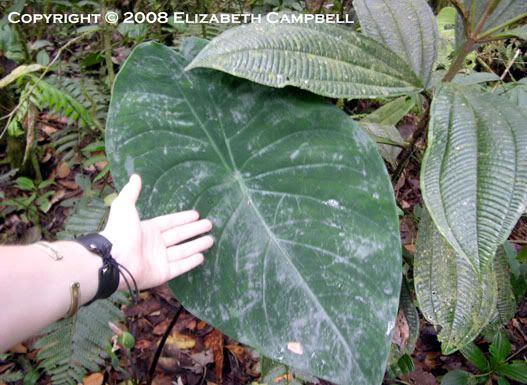 Variegated Form 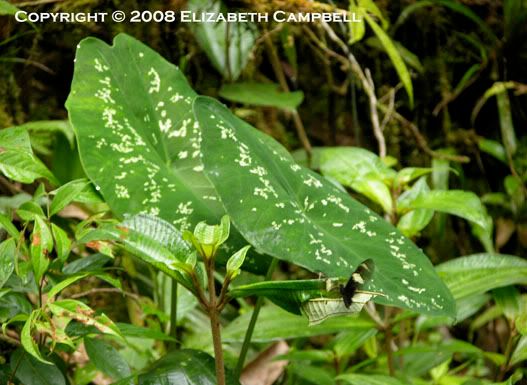 The more common "garden" Caladiums are normally cultivars of C. bicolor which have been bred specifically for their high red-variegation.  |
|
|
|
| Said thanks: |
|
07-19-2009, 02:36 PM
|
#14 (permalink) |
|
Rick

Location: California
Zone: 10a
Name: Zapper
Join Date: Apr 2009
Posts: 59
BananaBucks
: 47,459
Feedback: 4 / 100%
Said "Thanks" 6 Times
Was
Thanked 69 Times in 21 Posts
Said "Welcome to Bananas" 0 Times
|
Re: Colocasia/Alocasia
While the general consensus seems to be that the leaves of alocasia are smaller than that colocasia it must be rembered that Alocasia Robusta has the largest undivided leaf of any plant with Alocasia Borneo Giant a close second.
Rick |
|
|
|
|
07-19-2009, 02:56 PM
|
#15 (permalink) |
|
Mark
Location: Windsor u.k.
Name: Mark Hall
Join Date: Oct 2006
Posts: 616
BananaBucks
: 168,421
Feedback: 1 / 100%
Said "Thanks" 385 Times
Was
Thanked 282 Times in 123 Posts
Said "Welcome to Bananas" 15 Times
|
Re: Colocasia/Alocasia
I always thought it the other wat around. Alocasia have the bigger leaves. Colo Gigantia is a biggun , but the alocasias out number the colos for size.
A good site to check is IAS International Aroid Society Pretty all you want to know will be on there 
__________________
Time Flies like an Arrow.....Fruit flies like a Banana.
|
|
|
|
|
07-19-2009, 02:59 PM
|
#16 (permalink) | |
|
Nanner Time!
Location: Cedar Rapids, IA
Zone: 5
Name: Bryan
Join Date: Mar 2009
Posts: 2,937
BananaBucks
: 160,225
Feedback: 0 / 0%
Said "Thanks" 534 Times
Was
Thanked 2,243 Times in 1,245 Posts
Said "Welcome to Bananas" 855 Times
|
Re: Colocasia/Alocasia
Quote:
__________________
BANANA RAVE!Feel the beat from start to stop, dancin' and movin' from bottom to top! lilraverboi@genxglow.com RIP Tog Tan. We love you and will always remember you! I'm Bryan with a Y! There is no 'I' in BRYAN! |
|
|
|
|
| Said thanks: |
| | Are you a banana plant enthusiast? Then we hope you will join the community. You will gain access to post, create threads, private message, upload images, join groups and more. |
|
Sponsors |
|
07-19-2009, 04:32 PM
|
#17 (permalink) |
|
Banned
Location: Ecuador, South America
Zone: USDA 13 / Köppen-Geiger BSh
Name: Lorax
Join Date: Jul 2007
Posts: 2,532
BananaBucks
: 405,175
Feedback: 0 / 0%
Said "Thanks" 742 Times
Was
Thanked 3,040 Times in 1,188 Posts
Said "Welcome to Bananas" 464 Times
|
Re: Colocasia/Alocasia
Mark, I'm a member of the IAS, lol! What I gave were my guidelines for ID, of course, with the caveat that I'm often wrong, but in terms of what's available to these folks in the garden centers what I've said holds.
|
|
|
|
|
07-19-2009, 05:03 PM
|
#18 (permalink) |
|
Banned
Join Date: May 2009
Posts: 2,759
BananaBucks
: 184,966
Feedback: 0 / 0%
Said "Thanks" 1,364 Times
Was
Thanked 856 Times in 421 Posts
Said "Welcome to Bananas" 163 Times
|
Re: Colocasia/Alocasia
Ya know, considering some the incredible journeys she's made - not to mention discoveries - I think Lorax is being just a bit modest, here
....?Okay, okay.... .... I'm gone! |
|
|
|
|
07-19-2009, 05:41 PM
|
#19 (permalink) |
|
Orang Puteh
 
Location: Washington Twp N.J.
Zone: 6a
Name: bob
Join Date: Sep 2008
Posts: 3,529
BananaBucks
: 262,207
Feedback: 12 / 100%
Said "Thanks" 9,550 Times
Was
Thanked 4,062 Times in 1,695 Posts
Said "Welcome to Bananas" 565 Times
|
Re: Colocasia/Alocasia
So my Alocasia x Calidora, aka "Persian Palm", as well as Colocasia Gigantea are Elephant Ears but not really.
__________________

|
|
|
|
|
07-19-2009, 06:10 PM
|
#20 (permalink) | |
|
Banned
Join Date: May 2009
Posts: 2,759
BananaBucks
: 184,966
Feedback: 0 / 0%
Said "Thanks" 1,364 Times
Was
Thanked 856 Times in 421 Posts
Said "Welcome to Bananas" 163 Times
|
Re: Colocasia/Alocasia
Quote:
If it did Not come from that bulb, it's probably an Alligator, instead. However, your Colocasia is Definitely... somewhere in the Twilight Zone !!Okay , Please disregard as this post is now outdated & the sign has disappeared...Last edited by Eric : 07-28-2009 at 10:25 AM. Reason: Update |
|
|
|
|
|
Sponsors |
|
Email this Page
|
| Currently Active Users Viewing This Thread: 1 (0 members and 1 guests) | |
|
|