D&T, Caladium are part of the same tribe as Colocasia, Alocasia, and Xanthosoma.
These are smaller plants with only one or two leaves visible at any one time (up to 5 on newer cultivars, but never that many in the wild), a rhizome more like bananas, and much more variety in the colour their leaves, which are always velvety. Caladium, like Xanthosoma, are native to the New World (ie my neck of the woods), whereas Colocasia and Alocasia are Old World plants. The petioles are often very delicate (in the case of C. clavatum, so much so that they sometimes don't support the leaves) and the
leaves are edible when steamed, much like Spinach but with a better flavour. Caladium leaves normally exhibit more posterior-lobe fusion than the other three genera, and they're also (with the exception of
C. clavatum) a great deal smaller than the leaves of Colocasia and Xanthosoma.
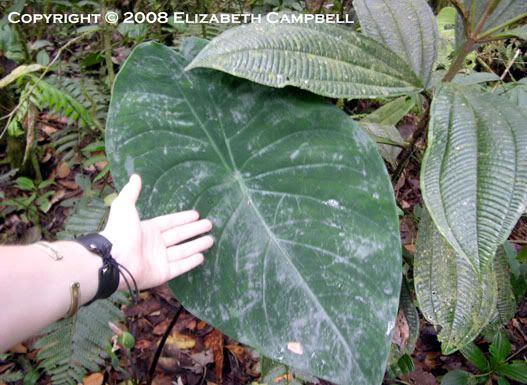
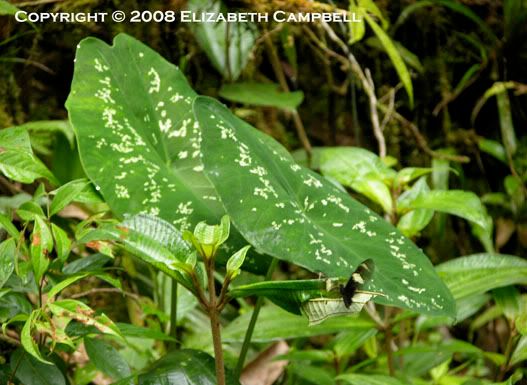
Here are the two variations of
Caladium steudnerifolium, which is Ecuadorean; scientists studying it have found that the variegation is a response to insect predation.
Solid Form
 Variegated Form
The more common "garden" Caladiums are normally cultivars of
C. bicolor which have been bred specifically for their high red-variegation.
