Colocasia are also normally much larger leaves than Alocasia, and there are fewer interesting colour variations in Colocasia. However, Mark's method of telling them apart becomes difficult when you're faced with the Xanthosoma-type Colocasias, which have non-flexed leaves.
A slightly easier way to tell from the leaves is by their structure. Colocasia tend to have well-defined anterior lobes, although the sinus (where the petiole and the leaf meet) is normally found below a fused portion of the anterior lobes. The petiole (leaf stalk) is normally of equal length to the leaf blade. The leaves of Colocasia also tend to be a great deal larger than those of Alocasia, especially given the cultivars that are normally available as "elephant ears" (a term which I despise, BTW.) Also, with the exception of Colocasia 'Illustris' which is purple, most commonly available plants have green leaves with a VELVET texture, while Alocasia tend to be WAXY and come in a wider array of variegations, often with well defined ribs on the leaves (see Alocasia 'Amazonica' for a good example of this.)
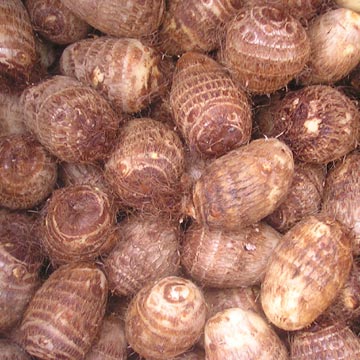
However, the easiest way to tell is to look at the tubers. Colocasia have large, swollen, banded tubers with easily visible "eyes" at either end. Alocasia tubers tend to be thinner, longer, and without the visible "eyes."
Colocasia (Taro) Tubers
Alocasia Tubers (Macrorrhizhos, botanical illustration)
