|
|
|
Welcome to the Bananas.org forums. You're currently viewing our message boards as a guest which gives you limited access to participate in discussions and access our other features such as our wiki and photo gallery. By joining our community, you'll have access to post topics, communicate privately with other members (PM), respond to polls, upload photos, and access many other special features. Registration is fast and simple, so please join our community today! If you have any problems with the registration process or your account login, please contact us. |
|
|||||||
| Register | Photo Gallery | Wiki | Map | Today's Posts | Search |
| Main Banana Discussion This is where we discuss our banana collections; tips on growing bananas, tips on harvesting bananas, sharing our banana photos and stories. |
 Members currently in the chatroom: 0
|
|
 |
The most chatters online in one day was 17, 09-06-2009. No one is currently using the chat. |

 Email this Page Email this Page
|
|
|
LinkBack | Thread Tools |
 11-26-2010, 06:55 PM
|
#1 (permalink) |

Join Date: Dec 2006
Posts: 786
BananaBucks
: 651,343
Feedback: 0 / 0%
Said "Thanks" 225 Times
Was
Thanked 598 Times in 209 Posts
Said "Welcome to Bananas" 0 Times
|
 The seedless fruits of Helen's hybrid
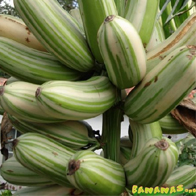
These are the pictures of the fruits of Helen's hybrid after 120 days of a
seedless experiment by a vegetable hormone. Observing the second picture,the experiment seems to have succeeded as no solid seeds are found and onlly very tiny grains of seeds. However the question is why the fruits did not grow as they should do in this period of 120 days. They never seem to have grown for 120 days and seem to be too much young. |

|


|
| Said thanks: |
 | Are you a banana plant enthusiast? Then we hope you will join the community. You will gain access to post, create threads, private message, upload images, join groups and more. |
|
Sponsors |
|
11-26-2010, 08:16 PM
|
#2 (permalink) |
|
Moderator
  
Location: Oahu, Hawaii
Zone: 12
Name: Gabe
Join Date: Jul 2005
Posts: 3,892
BananaBucks
: 13,504,497
Feedback: 5 / 100%
Said "Thanks" 2 Times
Was
Thanked 8,246 Times in 2,201 Posts
Said "Welcome to Bananas" 8 Times
|
Re: The seedless fruits of Helen's hybrid
They did not grow because they were not pollinated. Edible seedless bananas result from two separate events, one being the failure of fertilization (derived from many mechanisms) which results in lack of seed, and the second is parthenocarpy which results in growth and development of the fruit independent of fertilization.
In your experiment, there was no fertilization so of course there are no seeds. But the reason they didn't is because they are not parthenocarpic. Although you applied hormone to the exterior of the fruit, and it may have some type of effect on fruit growth, it is not a mimic of what happens during parthenocarpy and so cannot be regarded as equivalent. From the progress of the small experiments you have performed though, we can begin to infer some important things. More plants will need to fruit and be observed to confirm these observations, but this is the picture that is starting to form. 1. It is fertile and will set seeds when pollinated. 2. 'Helen's Hybrid' is not an edible banana. It is not parthenocarpic, it requires fertilization and seed development for fruit to develop. 3. Whether or not there really was an edible (parthenocarpic) cultivar involved in it's origins does not matter in terms of edibility, as it does not seem to be parthenocarpic. 4. 'Helen's Hybrid' is much closer to a wild banana than any domesticated edible cultivar. It may even be a wild species. There are still some questions regarding whether or not it is even a hybrid or not. From the very beginning since these seeds started coming onto the market, I was very doubtful they were an "edible, cold hardy banana you can grow from seed". These things just don't add up. For a banana to be able to be grown from seed easily almost automatically discounts it from being edible (parthenocarpic). The situation where you could really have an edible banana that you could grow seeds true to type would require a self-compatible, fertile, parthenocarpic plant. However, this is very rare and in order to end up with something like this, someone would have to add deliberately worked for a rather long time on actually breeding it, which is highly unlikely and has never been mentioned in it's (already weak) background information. Additionally, the word "hybrid" is thrown around a lot and used when it ought not to be used, as is the case of the Cavendish banana 'Williams' which also goes by the name 'Williams Hybrid' even though there is nothing justifiably "hybrid" about it.
__________________
Growing bananas in Colorado, Washington, Hawaii since 2004. Commercial banana farmer, 200+ varieties. |
|
|
|
| Said thanks: |
|
11-26-2010, 09:39 PM
|
#3 (permalink) |
|
Join Date: Dec 2006
Posts: 786
BananaBucks
: 651,343
Feedback: 0 / 0%
Said "Thanks" 225 Times
Was
Thanked 598 Times in 209 Posts
Said "Welcome to Bananas" 0 Times
|
Re: The seedless fruits of Helen's hybrid
Many thanks for your comment, Gabe, and I do well understood all what
you mentioned. As it was clear by my previous experiments that the banana was not parthenocarpic, I knew that it must be pollinated to keep the fruits growing. But on the other hand, my friend succeeded in making "Velutina" seedless by "Tomatotone" hormone and thus the velutina became ripe without seeds and he eat it like ordinary edible banana. This fact was the motivation for starting my seedless experiment with Helen's hybrid. Now the question is why it was posssible with "Velutina", but why not with "Helen's hybrid"? |
|
|
|
| Said thanks: |
|
11-27-2010, 05:58 AM
|
#4 (permalink) |
|
many 'naners, little time

Location: salisbury, UK
Zone: 8b ish
Name: Kev
Join Date: Nov 2006
Posts: 465
BananaBucks
: 396,737
Feedback: 3 / 100%
Said "Thanks" 202 Times
Was
Thanked 259 Times in 126 Posts
Said "Welcome to Bananas" 0 Times
|
Re: The seedless fruits of Helen's hybrid
Does anyone have any info on the origin of the name?
It is a plant of Indian origin (or at least a plant with Indian parents) and 'Helen' is not an obviously Indian name. I have asked both Ganesh Mani Paradhan and Kenibreed in the past, but neither have an answer.
__________________
a> |
|
|
|
|
11-27-2010, 06:47 AM
|
#5 (permalink) |
|
Zone 10, South Florida

Location: Royal Palm Beach
Zone: 10
Join Date: Aug 2006
Posts: 870
BananaBucks
: 181,404
Feedback: 1 / 100%
Said "Thanks" 30 Times
Was
Thanked 590 Times in 298 Posts
Said "Welcome to Bananas" 4 Times
 |
Re: The seedless fruits of Helen's hybrid
asacom,
I think as with basjoo, if the fruits are not pollinated they will not develop properly. Why is this? Perhaps when pollination occurs this sets in motion growth factors within the fruit itself to produce conditions (plump fruit) suitable for the fertilized embryos (seeds). Jeff Last edited by jeffreyp : 11-27-2010 at 06:50 AM. |
|
|
|
| Said thanks: |
|
Sponsors |
|
11-27-2010, 07:41 AM
|
#6 (permalink) |

Join Date: Mar 2008
Posts: 3,578
BananaBucks
: 33,394
Feedback: 1 / 67%
Said "Thanks" 3,829 Times
Was
Thanked 1,556 Times in 675 Posts
Said "Welcome to Bananas" 334 Times
|
Re: The seedless fruits of Helen's hybrid
Congratulations Asacomm,
Good research often raises as many questions as it attempts to answer!  |
|
|
|
| Said thanks: |
|
11-29-2010, 04:34 PM
|
#7 (permalink) |
|
Junior Member
Join Date: Mar 2007
Posts: 422
BananaBucks
: 25,558
Feedback: 1 / 100%
Said "Thanks" 29 Times
Was
Thanked 438 Times in 234 Posts
Said "Welcome to Bananas" 2 Times
|
Re: The seedless fruits of Helen's hybrid
Also bear in mind that most species bananas are 90% seed, so if you remove the seeds, you get a banana that is 10% the size of a seeded fruit.
|
|
|
|
| Said thanks: |
|
Email this Page
|
| Currently Active Users Viewing This Thread: 1 (0 members and 1 guests) | |
|
|
|
Similar Threads
|
||||
| Thread | Thread Starter | Forum | Replies | Last Post |
| The Helen's genuine fruits and the hibrid fruits | asacomm | Main Banana Discussion | 3 | 11-15-2010 07:55 AM |
| The fruits between Helen's and Basjoo | asacomm | Main Banana Discussion | 5 | 11-05-2010 04:11 PM |
| The flower and the small fruits of Helen's hybrid | asacomm | Main Banana Discussion | 1 | 09-09-2009 05:01 AM |
| Helen's Hybrid | the flying dutchman | Cold Hardy Bananas | 20 | 07-10-2007 05:54 PM |
| Helen's Hybrid | PaulOdin | Cold Hardy Bananas | 31 | 05-08-2007 09:58 PM |