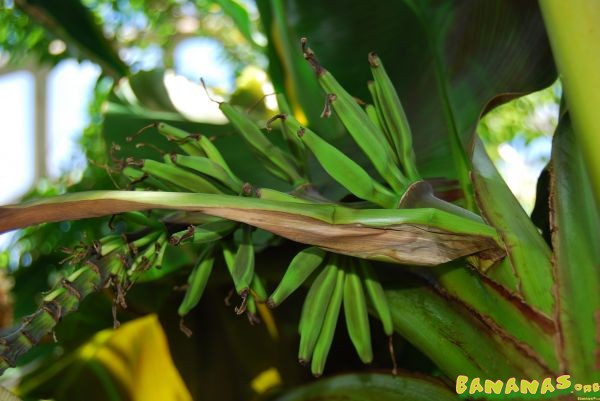
The 'Siam Ruby' I gave to the Denver Botanic Gardens years ago was planted in the conservatory about two years ago and is flowering at last. In line with my predication and what I was observed by a friend of mine who saw one flower in Florida, it indeed appears to be a wild plant, meaning no edible fruit. This is the first time the plant is flowering, so its true traits are not fully showing yet, and the male flowers appeared to have been eaten by something which is a big problem in pinpointing exactly what it is, but it is obvious it is a non-parthenocarpic plant. It may or may not be referable to some known taxon, likely some form of M. acuminata, but there is still more work to be done.
I examined some of the unopened flowers protected by the bract. They are not supposed to be used in formal descriptions as the color can change upon opening, if the anthers or style are to be exerted past the compound tepal it will only be noticeable when the flowers open, and pollen is not visible until flower opens, but they are fully grown so can still provide some useful information. One thing that was interesting about the flowers are the highly irregular free tepals. They actually varied quite a lot in apex shape and had a variable number of lobes. A few of the compound tepals were also irregular. Another interesting trait was the variable shape of the exertion point of the leaf lamina base to the petiole. They are normally consistent within a plant, but this plant had symmetric, left-handed asymmetry and right-handed asymmetry among different leaves of roughly the same age in the same mat.
Something like this could be a real trait of the plant, or it could be a somatic mutation resulting from tissue culture.Hopefully I can catch the plant flowering next time and take more notes.