
|
Florida Orinoco history ???
Does anyone know why Florida is covered in Orinoco? Who were the people that brought them here? Was this a Florida crop at one point?
|
Re: Florida Orinoco history ???
Quote:
|
Re: Florida Orinoco history ???
Who ate and grew them?
|
Re: Florida Orinoco history ???
Horse's?
Sorry... So many people call them Horse bananas. |
Re: Florida Orinoco history ???
Cattle food would make sense. Much of the cattle driven west were Florida cracker cattle.
|
Re: Florida Orinoco history ???
The plant is very prolific..
I got mine mid 1900'S near a strip club during spring break in Daytona Beach Fla.. Pup Farm...this plant is.  Untitled by Hostafarian, on Flickr |
Re: Florida Orinoco history ???
Just funny to me that a banana that nobody likes is so common. Had to be some sort of population that ate them. I fried some in coconut oil a couple weeks ago. I liked them that way.
|
Re: Florida Orinoco history ???
29 years ago the plant was also a great landscape plant...
This variety was all they had..... no choice . It compares to Arborvitae or a taxus as a foundation/accent plant up north. Pic taken on a bike ride on Huchinson Island @FPL nuke power plant gate d.  Untitled by Hostafarian, on Flickr |
Re: Florida Orinoco history ???
I moved here 23 years ago. The main banana people had That I knew of was whatever the dwarf banana was that was sold in novelty plant catalogs. We had one but it died. Bad planting I think. I remember people getting bananas if they were planted against the house.
|
Re: Florida Orinoco history ???
Would have been nice to have known 1993 what I know now
|
Re: Florida Orinoco history ???
Quote:
I've concluded that this is a hardy, cheap landscape variety that was planted much Leyland Cyprus, Arborvitae, Bradford Pears and other sturdy "no nonsense" trees are up North; its popularity can probably be traced to Yankees retiring to FL who wanted a carefree tropical plant but, heaven forbid, didn't want to grow food and seem to be a farmer. Having worked as a landscaper long after watching my mother pay dearly for a "beautiful garden" to hide a busy road (it didn't take long to become an overgrown eyesore) I know that installers do a job and move on after leaving behind what I consider high dollar trash plants. Pachysandra, Myrtle and Ivy are others that belong on my "should be eradicated list". That said, I suspect my 2 "left by the side of the road" musas are Orinocos which is fine with me; I'm new to growing them so am still playing. And who knows? I might really love them. Should I decide to shed them, I promise to dispose of them properly. :ha: |
Re: Florida Orinoco history ???
A major method of propagation I have witnessed is orinoco dumped out then picked up by people who spot them. Thats how I got mine.
|
Re: Florida Orinoco history ???
Quote:
|
Re: Florida Orinoco history ???
Quote:
-looks for the banana on a stripper pole emoji- |
Re: Florida Orinoco history ???
I like em cause they are tough as heck, can take burning full sun in 100+ temps, cold, solid clay, and will survive in suspended animation under my house in winter for 6 months. I would say they are everywhere there because they are super hardy, plus you can fry em, or eat them ripe, and they are an awesome ornamental, versatile. As to how they got there in the first place, people travel and bring back stuff. How did they get here in my yard, and I have started noticing them elsewhere around here lol, all from somebody that traveled to Texas probably and brought one back.
|
Re: Florida Orinoco history ???
Since they are common to cultures who fry them I assume at this point that they were grown as a plantain in south Florida later becoming ornamental to northerners moving to Florida. I don't know of any person to like them ripe. Most northerners don't know how to cook a banana. The Jamaicans here call them frog banana. So at this point I am going to assume the Orinoco is another south Florida migrant commonly fried in that culture.
|
Re: Florida Orinoco history ???
I enjoy them ripe out of hand and fried green and ripe. They produce very well. Our dwarf and tall orinocos are a favorite of my friend's two adopted children from Honduras.
|
Re: Florida Orinoco history ???
If you mention eating them here peoples faces turn wrong side out. I have to try dwarf orinoco still. I have a banana i am waiting for it to fruit to bring up an id but it looks just like orinoco and has been in this forest for many many years and gets sweet fruit. I am also trying to collect samples from different places. Right now I have 3 not counting the dwarfs.
|
Re: Florida Orinoco history ???
A few minutes ago I stopped for another sample. The plants are submerged in a lake and are fruiting like crazy. Both homeowners said they love them and use them as fruit toppings.
|
Re: Florida Orinoco history ???
I would say not just Fl. but all across the South. Ever been to South Louisiana? I've seen some monsters down there too. Here in Alabama they are the most common we see. I always recommend them to people who want to try growing a banana and especially if they don't have a green thumb. Orinoco are just about bullet proof and get by with minimal care. It's a great plant to get a novice into the Banana Realm. Once they see success, get out of their way, ha ha.
|
Re: Florida Orinoco history ???
I've never been to either of those states. It is just so strange how you can find these things in the middle of nowhere. I have 4 samples now. One was collected from a forest and seems to get only 7 feet tall. The one I collected today 12 feet and the saltmarsh one I collected has measured 16 feet. The history is in my imagination. Spanish trading with native americans in the 1600s maybe. Maybe orinoco is more than a single form of plant. This all peaks my curiosity.
|
Re: Florida Orinoco history ???
Who needs GMO when plants mod themselves all by themselves? ;) My 2 "by the road" finds are tall and were collected within 200' of each other so I suspect they're the result of pups shared within the same neighborhood. Obviously I need to get out more. Now that I have wheels again (sweet little 93 Ranger with new clutch, brakes, water pump, battery and only 95,600 miles), I've been traveling more than 6 miles from home. Guess I should buy that spare shovel and tuck it in her bed...just in case...
|
Re: Florida Orinoco history ???
From articles I've found in the past, bananas where introduced to Florida in the 16th century, definitely post European-American exchange, likely by Spanish and Portugese. I suspect that a few different cultivars were introduced initially, and that since Orinoco is hardy and resilient, it's stuck around relatively well with minimal management. As for the cultivar itself and the Bluggoe ABB subgroup, it's is from Asia like most banana subgroups and is not originally from anywhere associated with the Orinoco river in South America, but is certainly grown there as well as most places bananas grow. There are many other common names for this banana including: Bluggoe, Largo, Chamaluco, Burro, Cachaco and many others.
|
Re: Florida Orinoco history ???
I don't get to south Florida much but when I do I try to find cool things. Seems like every county around me has cool plants and plant sales but mine.
|
Re: Florida Orinoco history ???
It is everywhere due to its hardiness. Years from now there might be someone online talking about how so many people have Nam Wah. There was a small banana industry in Florida centered around dwarf cavendish in the early part of the 20th century.
https://news.google.com/newspapers?n...0,974894&hl=en https://www.floridamemory.com/items/show/70 https://www.floridamemory.com/items/show/27384 https://www.floridamemory.com/items/show/137257 https://www.floridamemory.com/items/show/137256 https://www.floridamemory.com/items/show/72 https://www.floridamemory.com/items/show/71 |
Re: Florida Orinoco history ???
Good finds. Your better than me at finding it.
|
Re: Florida Orinoco history ???
Quote:
|
Re: Florida Orinoco history ???
Quote:
:goteam::0519::ha::ha: |
Re: Florida Orinoco history ???
Quote:
:woohoonaner: |
Re: Florida Orinoco history ???
This fruit .comes from old Crystal River stock. Plants are very skinny and 12 feet tall. Flowers are small and fruits are very small and very sweet. Ultra hardy. One of my favorites.
  |
Re: Florida Orinoco history ???
This fruit has thick hard skin and is from a Rutland Florida homestead. Gets 7 feet. Plants were collected before the land was demolished.
 |
Re: Florida Orinoco history ???
This is the beast. 16 feet. Typical orinoco fruit. Backyard collected.
 |
Re: Florida Orinoco history ???
I still have others to go get.
|
Re: Florida Orinoco history ???
Wow! now that's an "Orinoco".
|
Re: Florida Orinoco history ???
I love my Orinocos, I opened the crawlspace today and looked at em, I waved and said night night lol
|
Re: Florida Orinoco history ???
They really are great bananas.
The first to leaf out, and they fruit reliably. And they taste good. I harvest the leaves for my goats and pigs, because they are such Fast growers. I'm not sure where they came from, but you can find them in deep Swamp to every ditch around the corner. So I'm sure that the history Behind them gos back way before they were just ornamental to igits. |
Re: Florida Orinoco history ???
These plants are the most reliable to flower and produce cute inedible fruit of the banana plants I have.
I really do think this plant is a good starter banana plant for a novice because it can withstand alot of "stuff" And this is in zone 6. Here is a double header. 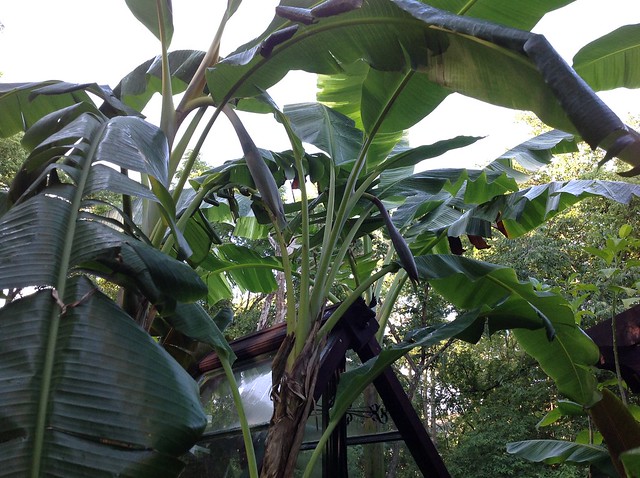 Orinoco flowers in zone 6 by Hostafarian, on Flickr |
Re: Florida Orinoco history ???
Quote:
|
Re: Florida Orinoco history ???
Quote:
Lol.... Yes, they make great filler plants up here in the valley. This is as good as it usually gets before the first frost. Like clockwork the plant will usually flag in late July. These are the old school nasty variety ..:) |
Re: Florida Orinoco history ???
Thats cool. Im learning here.
|
Re: Florida Orinoco history ???
And those even look the same.
|
Re: Florida Orinoco history ???
Quote:
I do want to clarify.....my plants are in containers:.....:ha::ha: These plants are not in the ground and do not overwinter outside.:08: |
Re: Florida Orinoco history ???
Even cooler
|
Re: Florida Orinoco history ???
I don't know about no one liking them but in southern California they are everywhere.
The population coming from tropical climates love them. Fried when green or eating out of hand when really ripe. Growing better varieties is for the gardening fan and lovers of bananas. |
Going Bananas
Anyone who has ever visited Going Bananas is sure to be impressed with teh banana patch that Bill Lessard started and Don & Katie Chafin have run so well the last 22 years!
Following is an interesting article: Going Bananas Yes, We Have Some Bananas, In All Shapes And Flavors For Desserts Or Side Dishes. December 5, 1991|By STEVEN RAICHLEN, Special to the Sun-Sentinel Remember the banana? It was bow-shaped and yellow, 6 to 8 inches long, and it probably bore a sticker saying Chiquita or Dole. You could buy it green, let it ripen at room temperature to the familiar canary yellow, then slice it into your cornflakes. If you think that`s all there is to bananas, think again. Today, there`s a bewildering variety of bananas: finger bananas no larger than your pinkie; Hawaiian bananas as big around as your arm; apple bananas that taste like a cross between a banana and a Macintosh apple; plantains, which must be cooked to be enjoyed, and more. Most Americans eat bananas only when ripe. But Latin Americans and West Indians use bananas when hard and green, when squishy soft and brown and at every stage in between. Most Americans eat bananas in their natural state -- raw -- or baked in banana bread. In other cultures, bananas are thin-sliced and fried like potato chips, boiled and mashed like potatoes, or even grilled like steak. In most cultures, too, a wide selection of bananas is commonplace. And increasingly, we are becoming familiar with them here. In Miami, my neighborhood Cuban produce market routinely carries six varieties. And mariquitas (green plantain chips), maduros (fried sweet plantains) and tostadas (mashed fried green plantains) are popular snacks not only among Cuban and Nicaraguan Americans, but among Miamians of all ethnic persuasions. Few Floridians know more about bananas than Bill Lessard. A former fighter pilot, he grows more than 50 varieties on his 7-acre farm in Redland, an hour south of Miami. ``The first time I saw a banana tree in Texas,`` recalls Lessard, ``I said to myself, `I have to grow these one day.``` A stint in Southeast Asia during the Vietnam years introduced him to many of the varieties he grows. ``I`ve prowled through every jungle in the world, looking for new ones,`` says Lessard, whose impressive collection bears out his claim. Lessard`s plantation offers quite an education on bananas. Consider the African rhino horn, a mammoth banana that weighs 3 pounds and measures 2 feet. ``The tree only produces 10 to 15 bananas a year,`` Lessard says. On the opposite spectrum, there is the Indonesian finger banana. A single bunch from this tree might contain 1,000 bananas no bigger than your baby finger. ``Here`s an up-and-comer,`` says Lessard, pointing to a banana that is lime green, 6 to 8 inches long and as big around as my forearm. ``Its name is huamoa, which means `rooster testicle` in Tahitian. It`s absolutely beautiful for frying.`` Introducing the huamoa to Miami`s Cuban community, however, Lessard renamed it Hawaiian banana, which is easier to say in Spanish. ``I can`t grow enough of them today,`` he says. Other prized specimens include the raga puri (a small, angular banana from India with a pinkish flesh high in sucrose) and the orinoco (a ``big, fat, super-sweet`` banana from Venezuela). And ``this one will grow 20 feet high in nine months,`` says Lessard, pointing to the saba banana tree from the Philippines. ``As for sheer beauty, you won`t find a prettier banana than the red iholene, whose skin looks like a tropical sunset when the fruit is ripe,`` he says. Several of Lessard`s exotic bananas are already a commercial success, including the tiny finger banana and apple banana, a small, fat fruit. Nor should one forget the plantain, a jumbo cousin of the commonplace banana that traditionally is cooked before it is eaten. Plantains are eaten at every stage of ripeness. When green (verde in Spanish), they are starchy and bland, like potatoes, and can be fried, boiled or mashed. Plantains also can be baked, like potatoes. Semi-ripe plantains (called pintados -- painted ones) are sweet and are popular mashed or fried. Maduros (literally ``ripe ones``) are as sweet as regular bananas and usually eaten fried. To taste a plantain at its sweetest, wait until the skin is completely black. Finger bananas, apple bananas, red bananas and plantains are available at some supermarkets and specialty shops. Look for them at any market that caters to a Caribbean or Latin American clientele. According to Lessard, bananas should be bought when they are yellow, with just a tinge of green. Let them ripen at room temperature until they are completely yellow; tiny brown spots, which Lessard calls ``sugar spots,`` begin to appear. Of course, bananas are also delicious green, as evidenced in the following recipes. Steven Raichlen is a free-lance writer living in Coconut Grove. Link to the entire article: Going Bananas Yes, We Have Some Bananas, In All Shapes And Flavors For Desserts Or Side Dishes. - tribunedigital-sunsentinel |
Re: Florida Orinoco history ???
Quote:
|
Re: Florida Orinoco history ???
Quote:
|
Re: Florida Orinoco history ???
Quote:
|
Re: Florida Orinoco history ???
|
Re: Florida Orinoco history ???
|
| All times are GMT -5. The time now is 03:57 PM. |
Powered by vBulletin Version 3.6.8,
Copyright ©2000 - 2026, Jelsoft Enterprises Limited.
All content © Bananas.org & the respective author.