
|
Musa yunnanensis officially described!
I was looking through the quarterly journal Novon, published by Missouri Botanical Garden, in last year's December issue today (next one comes out in March, etc.). I found an article in there that describes Musa yunnanensis and Musa acuminata var. chinensis. Both are found in the Yunnan province. It states:
"Musa yunnanensis grows abundantly in the Mekong River watersheds on slopes from 500-1800 m. The plants can tolerate seasonal frosts, which occur from Jan. to Feb. at higher elevations in Yunnan, China... ...seeds germinate easily even in shaded environments. However, these young plants then remain dormant for years. When exposed to light, the young plants thrive." OK, I thought the fact that the young plants stay dormant for years after germination was very interesting! The plants do tolerate shade, and in fact the plant is called the "tree banana" by locals because it grows under forest canopy. However, it doesn't really start to grow until exposed to some good light. It is also "cultivated up to 2100 m, and the stems used as animal fodder." Another interesting note: "The first author tentatively used the name Musa yunnanensis without describing it a few years ago (Hakkinen, unpublished data) when seeds came to commercial markets in Yunnan." That is interesting to me because I have been maintaining for some time now that the seeds and plants first offered to us as Musa itinerans are in fact Musa yunnanensis. Now, onto some key descriptors! "Plant normal, suckering freely, close to parent plant...mature pseudostem up to 5m...underlying color light green with purple-black blotches, waxy, sap watery...petiole to 70 cm, waxy, petiole margins curved inward with purple-black sparse blotching, petiole bases winged and clasping pseudostem, very waxy; leaf habit...narrowly elliptic, truncate at apex...leaf bases symmetric, both sides rounded and auriculate (having auricles, ears, or earlike parts, as the base of a leaf). ...Inflorescence at first horizontal and then falling vertically downward. ...Basal flowers hermaphrodite...Male bud lanceolate, ca. 12 X 4 cm, bracts red-purple externally, cream internally, with some wax outside, with pointed yellowish apex, lifting several bracts bracts at a time, revolute before falling, the whole bud aborting before fruits mature. ...Fruit bunch lax, with 8 hands and 15 fruits per hand on average, in 2 rows, fingers curved toward the stalk, individual fruit ca. 8 cm, curved with a pronounces ridge, pedicel ca. 22 mm, glabrous, fruit apex rounded, without relictual floral remains, immature peel color green, becoming light yellowish green with black blotches and splitting lengthwise at maturity....." That's the cliff notes version. So, let's compare some of these descriptors with my alleged Musa yunnanensis: "underlying color light green with purple-black blotches" "petiole margins curved inward with purple-black sparse blotching, petiole bases winged and clasping pseudostem, very waxy" "leaf habit...narrowly elliptic, truncate at apex" "leaf bases symmetric, both sides rounded and auriculate (having auricles, ears, or earlike parts, as the base of a leaf)." I had a hard time finding a picture of a darn leaf base, so it'll have to wait. But to sort of show what they look like, this Musa thomsonii leaf base is very similar (look at the biggest leaf on the right): As far as inflorescences, Eric in Orlando has pictures of them, and they and the fruit match the description perfectly. In my mind now, there is almost no doubt that this banana is Musa yunnanensis. Furthermore, it is a very cold-hardy banana! Mine comes back in March, for crying out loud, in zone 7a. Obviously, it is not Musa itinerans, so I'm not going to call it that anymore. It fits the description for Musa yunnanensis to a "T." Does anybody think otherwise? Gabe, inkcube, anybody else...I'd like to hear people weigh in on this with their opinions. I sure would like to positively ID this banana once and for all! Thanks, Frank |
Re: Musa yunnanensis officially described!
Looks like a match Frank!
|
Re: Musa yunnanensis officially described!
So is this the banana that was first introduced about 10 years ago (our seeds came from rarepalmseeds.com) as Musa "Yunnan" then thought to be M. itinerans actually M. yunnanensis? These are the ones that sucker close together, not like the M. itinerans var. xishuangbannaensis which produces suckers up to several feet away
These are some photos of Musa itinerans (Musa "Yunnan") 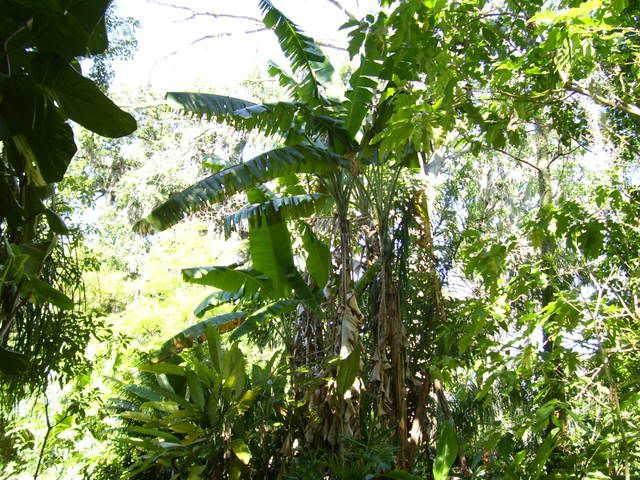 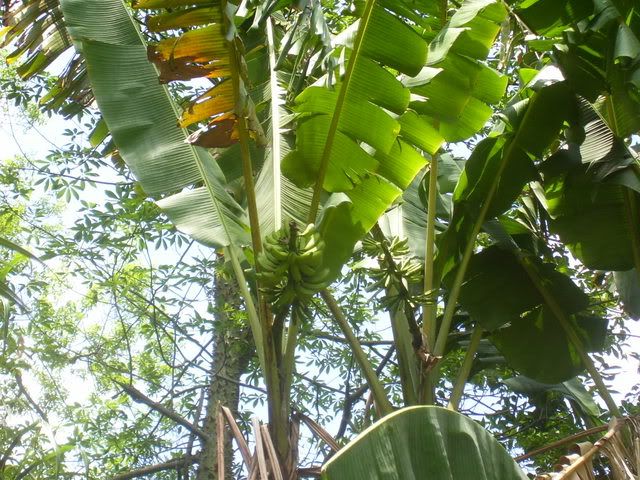 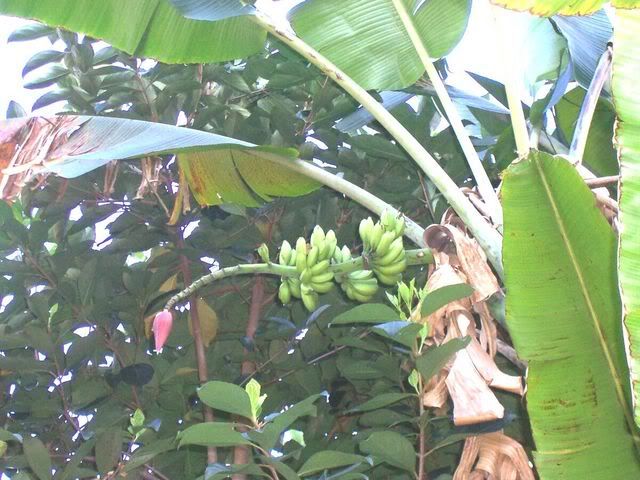 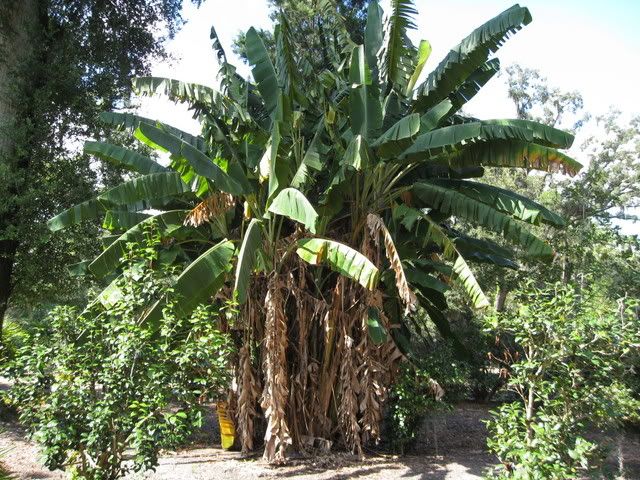 |
Re: Musa yunnanensis officially described!
Thanks for those pics, Eric! That's the plant. Do you guys subscribe to Novon at Leu? You should go find a university library, or a library down there that has it, and key it out. I'm almost 100% positive that the banana in the pictures is Musa yunnanensis. Let me ask you this: Do the plants in your pictures form seeds, even without another bloom open? Musa yunnanensis has basal hermaphroditic flowers, so it would form seeds with just one inflorescence open.
I'll say this about the banana in your (and my) pics: It is definitely NOT Musa itinerans! The easiest distinguishing characteristic about itinerans is the long rhizomes. |
Re: Musa yunnanensis officially described!
We don't have a subscription, I will have to check into it.
Yes, these seed and quite often we get clups of seedlings coming up throughout the Gardens (50 acres). I think racoons spread them. The last photo is a clump that sprouted up from seedlings and only took a couple years to get that big. When these were first ID'd as M. itinerans I always wondered as they did not have stolons or produce suckers aways from the parents like the descriptions said. |
Re: Musa yunnanensis officially described!
So this means that the one from agri starts(M.initerans) is actually M. yunnanensis...right?
|
Re: Musa yunnanensis officially described!
Eric,
Hey! I see that you work at Harry P. Leu Gardens in Orlando. I'm assuming that you are the Eric who wrote the recent article "Go Bananas" in the publication Ornamental Outlook? That was a great article and a good way to introduce more people to the ornamental bananas out there. I think it is mostly people in the horticulture/grounds maintenance industry that read it though. I've read some of your articles before but never realized exactly who it was writing them until now. I'll have to look into this Novon publication. I worked at the Missouri Botanical Garden for over 5 years and I don't remember ever even hearing of it. I assume that it is put out by their Research division and I was in Horticulture, so maybe that's why. Does the yunannensis produce edible fruit? Looks like a cool banana for sure! |
Re: Musa yunnanensis officially described!
That is me! I write a monthly article on some type of group of plants. This time it was ornamental flowering bananas. Glad you enjoyed the article, OO is more of a trade magazine but always has some good articles.
I don't know how the fruits are. They're not real big and lots of seeds. One of those that you could crack a tooth or filling if you weren't careful. Quote:
|
Re: Musa yunnanensis officially described!
If you search yunnanensis in the gallery there are pictures of the one I imported from Nature Products (Tian Zi), so you can use that as reference too.
|
Re: Musa yunnanensis officially described!
I actually grew a bunch of these for a chimpanzee sanctuary in Ft. Pierce. Save the Chimps ( savethechimps.org ) has acquired an old Air Force facility in New Mexico that housed a few hundred chimps, some dating back to the early space days. They were used in space travel research or loaned out for medical research. They have 100 acres now west of Ft. Pierce and are bringing them to FL. They live in groups on islands where they are free to go outside.
Their website said they could use donations of banana plants. I asked if they were for fruit but they said no, mainly for browse. The chimps love to eat the leaves or play with them and make nests. This banana seems to be a more tolerant banana here to drier soil and nematodes. They also seemed to form a thick clump faster with lots of foliage so I collected a bunch of the seedlings I found growing wild and potted them up. Once they grew a little I took them over. |
Re: Musa yunnanensis officially described!
Quote:
Eric, That is one of the coolest projects I have heard of... Seems like I read something about the chimps awhile back... So, you are saying that they moved them from NM to FL? Man, I think what you did was awesome. Good luck with your future endeavors with this project... :2720::2720::2704::2720::2720: |
Re: Musa yunnanensis officially described!
Quote:
The article mentions that monkeys and bats are primarily responsible for seed dispersal. It says that seeds are "nearly flat, wrinkled, ca. 3.5 mm diam., 80-100 seeds per fruit." It also mentions that M. yunnanensis is affined to a M. acuminata group. Another interesting part of the article describes several species found in the Yunnan province in areas where seasonal frosts occur:" Ensete glaucum (Roxburgh) Cheesman, Musa acuminata Colla, M. balbisiana Colla, M. basjoo Siebolt, and M. itinerans Cheesman, as well as other misidentified banana species." I'd be curious as to which M. acuminata variety is cold-hardy. Novon is published by The Missouri Botanical Garden Press, and is a journal for botanical nomenclature. It's pretty much dedicated solely to describing new species, renaming, or reclassifying known species. It's only been around since 1991. For citation purposes, this volume is Volume 17, no. 4, pp. 440-446. I know that the Musa itinerans is supposed to cleared up in an upcoming issue of Novon, so I've been keeping my eyes peeled for it! |
Re: Musa yunnanensis officially described!
Quote:
|
Re: Musa yunnanensis officially described!
They have 286 chimpanzees. They have moved 134 to FL and have 152 left in NM that they hope to move here in the next 2 years. Its a great organization
Quote:
|
Re: Musa yunnanensis officially described!
Quote:
|
Re: Musa yunnanensis officially described!
Gabe, here's the black on the midrib in my plants:
And one in your gallery: That's really odd about the leaf bases. They are very different from the description! |
Re: Musa yunnanensis officially described!
Cool. This is what I love about this forum.
Zac |
Re: Musa yunnanensis officially described!
Well, I have just received word from Professor Hakkinen that the plants I and Eric have posted pictures of are indeed Musa yunnanensis! Nice to hear that from the gentleman that described them.
Gabe, he said that the plant in your pictures is Musa itinerans var. itinerans, which would explain the difference in leaf bases. Otherwise, the two plants look very similar, which would explain the confusion. This makes me wonder about the seed dealers. I have seen pictures of plants labeled as Musa itinerans that look very similar to Musa yunnanensis from a distance, but differences become more obvious up close. Any Musa itinerans that I've seen, so far, appears to have a reddish-splotched pseudostem as it gains some size to it. Musa yunnanensis does not. I'd be willing to bet that there are plants of both species out there, all being sold as Musa itinerans. |
Re: Musa yunnanensis officially described!
Cool. Wierd...but cool. I had thought I showed him pictures of mine before, but maybe not.
|
Re: Musa yunnanensis officially described!
Even more of why I like it here!
Zac |
Re: Musa yunnanensis officially described!
Yeah, definitely weird, but very cool! So nice to finally get at least one of these mysteries straightened out.
|
Re: Musa yunnanensis officially described!
The very idea of a young Musa remaining dormant for years...yet being exposed to seasonal frosts during those years! That is very spectacular. This might end up being THE Cold-Hardy Banana!
|
Re: Musa yunnanensis officially described!
Rob, I had to go back and read that several times to make sure I wasn't just tired or something. They just sit there and wait for the canopy to open up, then take off like a normal banana would do in sunlight. The Chinese call Musa yunnanensis "Lv Bajiao" - "Lv" means green and "Bajiao" is banana. The Dai name is "Boguimen" - "Bo"=tree, "Gui"=banana, "men"=wild. We were initailly told that this banana needed shade to grow well, but some of us tried it in full sun with success anyway. It probably would be a great banana for the PNW or anywhere in Cal. And your point about the young plants being exposed to seasonal frosts makes you think too. I will say that it started growing for me before any other banana in my yard. I first noticed it sprouting back on March 13th, several weeks before our last frost!
|
Re: Musa yunnanensis officially described!
Frank, thanks for your effort in clearing up the naming confusion.
|
Re: Musa yunnanensis officially described!
Thrilled to help! I've had my suspicions for quite some time now, but the official description left little doubt, and Professor Hakkinen erased what doubt was left.
Now if we could just get ahold of some Musa itinerans var. itinerans seed! It's out there somewhere. I've seen several pictures on this board of the plant, mainly in Europe. |
Re: Musa yunnanensis officially described!
So how many varieties of Musa itinerans are there?
Has it been determined that what is being sold as 'Burmese Blue' is M. itinerans var. guangdongensis ? |
Re: Musa yunnanensis officially described!
Now you guys really have my interest! I bought a 'Burmese Blue' last year off of E-bay. I'm hoping that that's what it really is. It seems to be from the descriptions I've read, but I guess I won't know for sure until it flowers and fruits. See my gallery for a photo or two of it.
Quote:
|
Re: Musa yunnanensis officially described!
I got some photos of a big clump of Musa yunnanensis. This clump sprouted in situ in 2005. The seeds were spread probably by racoons. The fruiting plants are on the opposite side of the Garden which is 50 acres. Sorry that the last photo of the trunk coloring is blurry, it looked clear on the camera screen.
    |
Re: Musa yunnanensis officially described!
Quote:
There are about 6 to be described I believe, maybe another one later on. Every 'Burmese Blue' I have seen is very consistant with Musa itinerans, so I would think its safe to go with that. |
Re: Musa yunnanensis officially described!
We have grown 2 clumps of Musa "Burmese Blue" but neither have been very vigorous. They do produce suckers aways from each other. Here is the inflorescence of one;
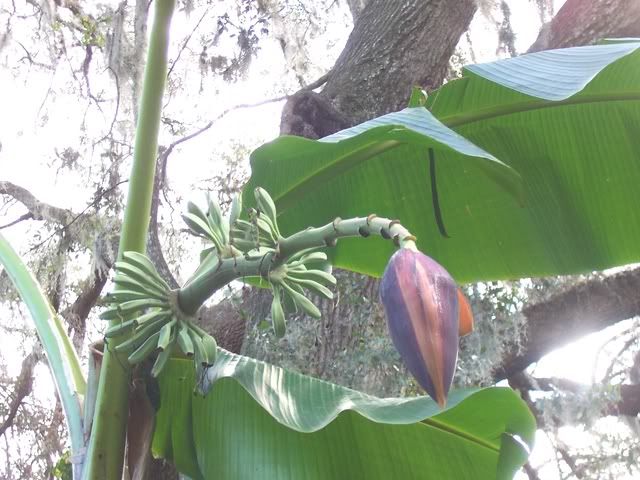 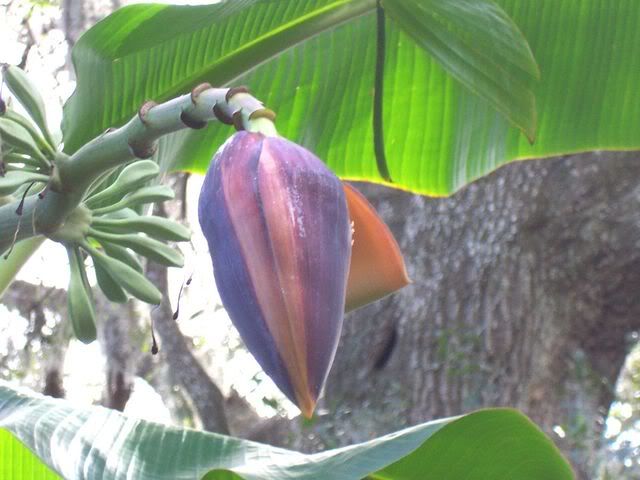 |
Re: Musa yunnanensis officially described!
The Musa itinerans article comes out in the March issue of Novon. I am very much looking forward to it! It should clear up a lot.
|
Re: Musa yunnanensis officially described!
Eric,
I haven't found my Burmese Blue (if that's what it is) to be overly vigorous either. Last year (first year in the ground, received as about a 6" plant) it got to be about 5' tall with about 2 pups. The fruit on the pics you posted don't look to have the bluish-purple look that is always described with that fruit. What gives? |
Re: Musa yunnanensis officially described!
Do they turn color as they develop? How tall is the one in your photos?
|
Re: Musa yunnanensis officially described!
They never got any bigger than that then they shriveled up, never fully developed. I never go to see if they turned blue. We had one other flower but it never even set fruit.
|
Re: Musa yunnanensis officially described!
Thanks, I'll be sure to let you know what mine does this year. Sorry, I know this thread wasn't originally about BB, but you guys mentioned it so I threw my questions out there!
|
Re: Musa yunnanensis officially described!
Quote:
I found it to be cold hardy compared to the other initerans(besides agri-starts M.initerans(yunnansis)). |
Re: Musa yunnanensis officially described!
sorry to continue to hijack this onto burmese blue
my understanding is also that the european view is that it is M. itinerans var. guangdongensis. great photos eric, awesome inflorescence. I take it someone will continue to post these classification updates. I have faith in Markku, but not necessarily in the Chinese... |
Re: Musa yunnanensis officially described!
I found the article today online, doing a Google search, and free. Here's the link (please don't ask me why it's in the flora of N.A.!):
FLORA OF NORTH AMERICA |
Re: Musa yunnanensis officially described!
Bump
So are we still agreed that Musa 'Mekong Giant' is actually Musa yunnanensis? Just ordered one from Brian; I'll use the checklist when it starts growing well. |
Re: Musa yunnanensis officially described!
Saltydad-I have three from Brian, planted oh about end of May. The weather has only started to warm up a few weeks ago. They are really starting to take off now, although they are still small. The leaves and pseudostem do NOT look like Musa Yunn at this point, at least not like the ones I had in the past. I will keep you up to date. If I get some time in the next few days I will take a couple pics if you are interested.
Eric |
Re: Musa yunnanensis officially described!
Thanks, I'd appreciate it!
|
Re: Musa yunnanensis officially described!
Howard, the 'Mekong Giant' from Brian is actually Musa itinerans (probably var. itinerans), not M. yunnanensis. Not sure why he doesn't just call it what it really is, and avoid the unnecessary confusion.
Frank |
Re: Musa yunnanensis officially described!
Thanks Frank, I agree. It would save a lot of head scratching (and I don't have that much hair anymore).
|
Re: Musa yunnanensis officially described!
My Yunn has wax on it, my Mekong Giants don't. The Mekongs have reddish brown markings on the pesudostem that run up into the petiole. The underside of the leaves have quiet a bit of the same reddish brown coloring. Also there are about 14 prominent lateral veins off the midveins. They also seem to be growing pretty quick now. I did talk to Brian some months ago about the identity of it.
Eric |
Re: Musa yunnanensis officially described!
Here are those pictures:
Top of leaf with prominent veins. I counted 14 on each side on this small leaf. Bottom of leaf with a lot of color: Pseudostem. It is hard to see that some of the reddish brown color is starting to appear. No wax: Eric |
Re: Musa yunnanensis officially described!
? so did the question of ?is the mekong giant a
yunnanensis.. itinerans..? ive been thinking of ordering couple from brian.. how have u done with yours eric? how big have yours gotten this summer? thanks.. |
Re: Musa yunnanensis officially described!
It's funny you ask nanner cause I just took new pics of it and was planning on posting them in a few days. I think you would be very happy with it. MIne is growing fast, from a 4" pot to over 4 feet and we had really cold weather here until late June. It grows really fast and looks great. Liek Brian says it does seem to gorw faster than basjoo. We had a hot JUly which didn't slow it down at all.
It is an itinerans, although none of mine have pupped yet. I used Dr Hakkien's article to try to establish what var and it appears to be very similar to Musa itinerans var xishuangbannaensis, if you can believe that! I just don't know if it has watery red sap cause I haven't had the heart to cut it! Anyway it even has very tiny bits of wax showing up on the petioles, that are very easy to miss. So I could be wrong but running through the checklist it sure matches his description of it. Eric |
Re: Musa yunnanensis officially described!
thanks eric!! im always a sucker to try something new..
:) so do cut it down in fall/winter and store then...just storing the bulb? ive always been pleased with brians plants.. we are getting a HOT streak this week..high 90sF whew.. nites are still real comfortable.. |
Re: Musa yunnanensis officially described!
I know what you mean nanner! It's a huge problem isn't it? Well I suppose this one you could treat just like any other banana adn cut it if you want. I don't know what the size of the corm is on it yet, but it has gorwn very rapidly. And Brian says the corm does get massive. I plan on leaving them outside for the winter and mulching the same as I do for my basjoo, and if they make it great! I have enough to bring in and carrying pots in and out every year just doesn't do it for me anymore.
Yes I'm always happy with his stuff. Never disappointed. I'll work on getting nee pics up this week for you. I woul dat least, if nothing else, pick up one or two adn grow them in pots over winter if you can. They might be too small to store at this point just as corms. Enjoy that heat for me! It has been kinda cool here in the 70s for the most part. But big storms loom, just in time to shread my plants. |
Re: Musa yunnanensis officially described!
Nanner here are some pics. Took awhile sorry. It is about 5 feet tall now.
It has grown fast, and the purple black color is showing up now. Also there are tiny smudges of wax on the petioles in some places. I used Dr Hakkien's Itinerans article and the features all (so far) match Musa Itinerans var xishuangbannaensis. Purple black smudges on petioles starting to show up: Midrib on underside of leaf still has color: Pseudostem has a yellow color (not obvious in this picture): Eric |
| All times are GMT -5. The time now is 02:01 PM. |
Powered by vBulletin Version 3.6.8,
Copyright ©2000 - 2026, Jelsoft Enterprises Limited.
All content © Bananas.org & the respective author.