|
|
|
Welcome to the Bananas.org forums. You're currently viewing our message boards as a guest which gives you limited access to participate in discussions and access our other features such as our wiki and photo gallery. By joining our community, you'll have access to post topics, communicate privately with other members (PM), respond to polls, upload photos, and access many other special features. Registration is fast and simple, so please join our community today! If you have any problems with the registration process or your account login, please contact us. |
|
|||||||
| Register | Photo Gallery | Classifieds | Wiki | Chat | Map | Today's Posts | Search |
| Other Plants Discussion of all other types of plants besides bananas. |
|
Hey there! It looks like you're enjoying Bananas.org but haven't created an account yet. Why not take a minute to register for your own account now? As a member you get access to all of our forums and posts plus the ability to post your own messages, communicate directly with other members and much more. Register now! Already a member? Login at the top of this page to stop seeing this message. |
 Members currently in the chatroom: 0
|
|
 |
The most chatters online in one day was 17, 09-06-2009. No one is currently using the chat. |

 Email this Page Email this Page
|
|
|
LinkBack | Thread Tools |
 04-27-2009, 12:59 PM
|
#1 (permalink) |
|
Senior Member
Location: Davis, California USDA zone 9
Join Date: Jul 2005
Posts: 1,034
BananaBucks
: 612,184
Feedback: 1 / 100%
Said "Thanks" 108 Times
Was
Thanked 474 Times in 228 Posts
Said "Welcome to Bananas" 16 Times
|
 Stone fruits without the stone!
Some of the fruits of my plums, pluots and plumcots that I have grown have no seeds (or shriveled) but there is still that hard pit shell that encapsulates the missing seed. I was trying to grow some pluots and plumcots from seeds, but after several failed attempts, I began dissecting them and found that many of them have malformed seeds, or shriveled, or sometimes missing. Practically, all the fruits of my Flavorella plumcot that I have disected have no seed inside, only the hard shell. It could only be a sterile hybrid, perhaps, one of the qualities that Zaiger genetics have intentionally chosen from amongst their various hybrids, to asxually propagate and sell so that all their hardwork in the form of viable seed will not be passed on to others to build upon. It is legal to propagate by seeds but not asexually, and if the seed is sterile, then the intellectual property rights are protected, and so I will not be surprised if most of the Zaiger hybrids are sterile when they hit the retail market. But such sterile hybrid is one step to producing Plums or Pluots without Pits. Burbank on the other hand, have found stoneless selections, but still with a naked seed. If we can combine both the sterile seed and Burbank's selection of stoneless plums, then we can have totally seedless stone fruits. Well, one quick trial could be done, like application of GA3 to produce seedless fruits. If Burbank's slection are sprayed with GA3, then we may have stoneless seedless "stone" fruits, a new oxymoron term, but may have premium price when marketed. Perhaps, one day, stone fruits without pits. Imagine, cherries without pits. Here's the latest USDA announcement in April 2009 about such topic. Click the link below for the original article.
Joe Real From: Plums Without Pits Plums Without Pits 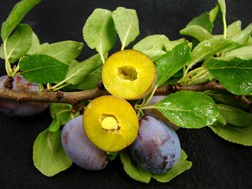 Ripe plum fruit from one of Burbank’s remaining stoneless selections. The fruit is cut to reveal a naked seed surrounded by a cavity where the stone would normally form. (D1388-1) How great would it be to sink your teeth into a perfectly ripe plum without having to worry about how to inconspicuously dispose of that pit? Molecular biologists Chris Dardick and Ann Callahan and Prunus breeder Ralph Scorza are looking for the genes that control pit formation in plums—the first step in blocking their development. The research team works at the ARS Appalachian Fruit Research Station in Kearneysville, West Virginia. Fruit pits consist of the seed and the hard woody material, or stone, surrounding the seed. The stone is considered a nuisance by consumers and processors. “Pitless fruit varieties would be a premium product that could provide higher income for growers and could increase consumption of these nutritious foods,” says Dardick. It could also save fruit processors money, because pit removal and disposal are costly practices. The Quest for Pitless Fruit The idea of pitless, or stoneless, fruits is not new. In the early 1900s Luther Burbank, a prolific horticulturist, crossed a partially stoneless wild plum with California French prune varieties. These crosses led to commercial-quality fruit that almost completely lacked the stone, but still contained the seed. Burbank’s work demonstrates that stoneless fruit can still hang onto the tree, reach appropriate size, and attain commercial quality. “Since Burbank’s death in 1927, we’ve only been able to find three sources of his stoneless plums in germplasm repositories, and it’s not yet clear if they are all the same,” says Dardick. “Most of Burbank’s stoneless varieties have been lost, but we have some of the trees from the repositories growing in our orchard. We have initiated crosses with these trees to start a new breeding program, but the trees are still immature and therefore do not yet produce fruit. In addition, we engineered Burbank’s stoneless variety with an early-flowering trait that will greatly speed up the breeding program. The resulting fruit has remarkably little stone tissue, but further improvements are still needed to make it edible.” A Look to the Future To create truly pitless fruit, it is necessary to eliminate both the stone and the seed inside. “We have begun projects to address both issues. These take advantage of both traditional breeding—using Burbank’s plums—and genetic engineering,” says Dardick. “Our group discovered that a set of genes necessary for production of lignin, a material for stone formation, is rapidly turned on specifically in stone tissue—not the flesh or skin—just before hardening, and then quiets down just as quickly after the stone hardens,” says Dardick. “The goal is to establish techniques to stop the genes’ activity and prevent hardening.” In 2008, another team member, Chinnathambi Srinivasan, a plant transformation specialist, genetically engineered early-flowering plums that produce fruit in 6 months instead of the usual 4-5 years. Srinivasan now has several plum lines that are being further developed for experimental use. Early flowering will substantially shorten the time it takes to test the strategies. “If it’s successful, we hope the research can be applied to other stone fruits, such as cherries, peaches, nectarines, and apricots,” Dardick says. While pitless stone fruits won’t be on store shelves anytime soon, the study of plum stones may also have important implications for forestry or biofuel crops—in which lignin is a key source of fiber strength and energy storage. Manipulating lignin levels in plants has proven difficult. New studies suggest that plum stones contain extremely high levels of lignin. Understanding how they accumulate so much lignin may open up new opportunities for enhancing wood properties in trees or developing high-energy-density biofuel crops.—By Sharon Durham, Agricultural Research Service Information Staff. This research is part of Plant Genetic Resources, Genomics, and Genetic Improvement, an ARS national program (#301) described on the World Wide Web at ARS : National Programs. Chris Dardick is with the USDA-ARS Appalachian Fruit Research Station, 2217 Wiltshire Rd., Kearneysville, WV 25430; phone (304) 725-3451, fax (304) 728-2340. "Plums Without Pits" was published in the April 2009 issue of Agricultural Research magazine. |

|


|
| Said thanks: |
 | Are you a banana plant enthusiast? Then we hope you will join the community. You will gain access to post, create threads, private message, upload images, join groups and more. |
|
Sponsors |
|
04-27-2009, 01:46 PM
|
#2 (permalink) |
|
Senior Member
 
Location: Seattle, WA
Zone: 8-9
Name: Chong
Join Date: Nov 2006
Posts: 1,851
BananaBucks
: 119,931
Feedback: 6 / 100%
Said "Thanks" 1,309 Times
Was
Thanked 1,702 Times in 759 Posts
Said "Welcome to Bananas" 991 Times
|
Re: Stone fruits without the stone!
Thanks, Joe,
Where can we get scions for grafting of these? And when is the time to graft them? |
|
|
|
|
04-27-2009, 01:51 PM
|
#3 (permalink) |
|
Senior Member
Location: Davis, California USDA zone 9
Join Date: Jul 2005
Posts: 1,034
BananaBucks
: 612,184
Feedback: 1 / 100%
Said "Thanks" 108 Times
Was
Thanked 474 Times in 228 Posts
Said "Welcome to Bananas" 16 Times
|
Re: Stone fruits without the stone!
You can practically graft year round in some USDA zones if you can get fresh scionwood. I don't know yet where to get these special selections, perhaps one of the USDA germplasms. the best to use would be the dormant scionwood from the germplasm and then graft in spring. the order deadline I think is in December, but check with the USDA germplasm website. I don't mark the link as they often changed, and I search for the links again starting in September when I scroll through what I want to order. Will let you know when the requests for scionwood are available sometime late this year.
|
|
|
|
| Said thanks: |
|
Email this Page
|
| Currently Active Users Viewing This Thread: 1 (0 members and 1 guests) | |
|
|