
|
Bunchy top virus?
I have a dwarf cavendish banana plant that seems to have 'bunchy top virus'. Can any of you confirm my suspicions?
If it is infected, I've read they might still produce bananas, but could infect the rest of the plants growing in the matt. So, I guess the answer to my next question is obvious, but should I cut it down? 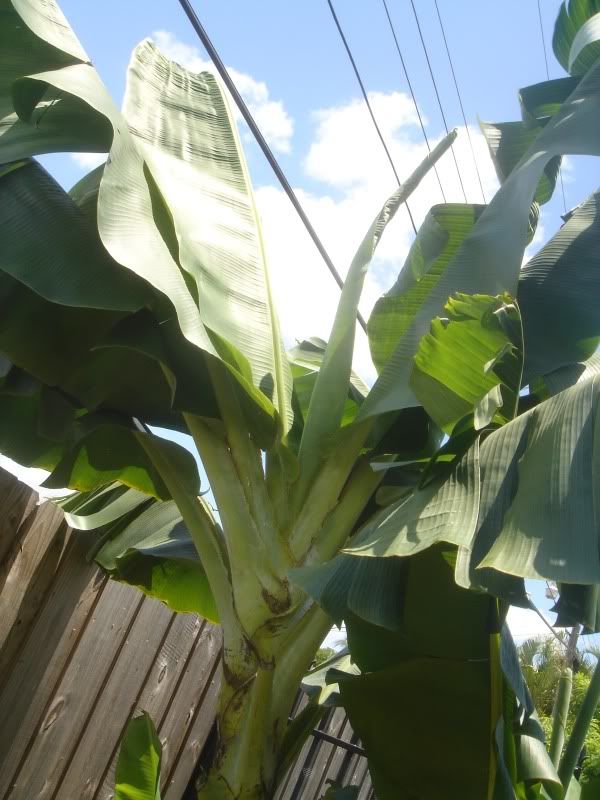 |
Re: Bunchy top virus?
Your plant looks completely healthy and I see no problem at all. Typically when the extension/height between each petiole decreases, it is a sign that it will either bloom or occasionally needs some fertilizer. In the case of your plant, I would expect a bloom pretty soon, which of course comes after a flag leaf.
This is what Banana Bunchy Top Virus looks like:  It seems there is an epidemic lately of people thinking they have BBTV here on the mainland. It is fairly common and very problematic in Hawaii, but rarely is found here in the US, even in Florida. I actually don't know of any cases here because the insect that transmits it doesn't live here, the Banana Aphid. I hope my information above is all correct, but I'm sure someone will let me know if it isn't. |
Re: Bunchy top virus?
Excellent. Thanks for the quick response!
|
Re: Bunchy top virus?
Yeah, I agree...your plant looks just fine. Bunchy top looks a lot different with small/narrow leaves all packed in there at the top. Cavendish varieties often tend to have short distances between successive leaves....nothing to worry about though. It looks just fine to me!
|
Re: Bunchy top virus?
One may diagnose banana bunchy top more accurately by observing the more subtle disease symptoms associated with leaf veins (Morse code, green J-hooks) and petioles (mottling), rather than the "bunchy" appearance of leaves, which can have other causes (i.e., nutrient deficiency, herbicide injury).
You can watch our video at youtube about the banana bunchy top disease if you want to learn more about recognizing the subtle symptoms on leaves: Part 1: YouTube - Banana Bunchy Top in Hawaii (Part 1) Part 2: YouTube - Banana Bunchy Top in Hawaii (Part 2) You may also visit my banana bunchy top website for more photos and information: Banana Bunchy Top Disease in Hawaii: Symptoms, Diagnosis and Management Scot :03: |
Re: Bunchy top virus?
I think your plant just has awesome growth.... good job!!!
|
Re: Bunchy top virus?
Thanks for another great set of videos Scot!
|
Re: Bunchy top virus?
Quote:
Scot:03: |
Re: Bunchy top virus?
Good evening Dr. Nelson,
Is there a known or calculated rate of Bunchy Top infection in Hawaii? It seems that the control measures are effective. Is this accurate, and how can it be calculated? :2239: |
Re: Bunchy top virus?
here is an old pic of my dc that did just fine.
|
Re: Bunchy top virus?
Quote:
One would evaluate models until the best-fitting one is found. After applying disease control measure(s) such as eradication of diseased plants, calculate r to see the reduction in the value for the parameter. One would have to have multiple plots of plants in an experiment to accomplish this. For various reasons, I have not bothered to do that yet, Caloosamusa. Control measures are successful in Hawaii, such as selection of planting location, selection of banana variety, planting disease-free pups (tissue culture, for example), and scouting for and eradication of diseased plants and control of banana aphids. Where no control is practiced, a farm could suffer a very high proportion of infected plants. Scot :03: |
Re: Bunchy top virus?
I've worked with best fit modeling in my Graduate geology courses, on rates of species evolution. In my Ecology classes we've also applied some techniques to population growth models (after disturbance events). Actual fits are "rough."
What is a Gompertz model? Or what Journal was it published in? Thank you Dr. Nelson. |
Re: Bunchy top virus?
Quote:
https://www.msu.edu/user/staatz/Staatz-Comparison.pdf I think a Brit developed the model for actuarial tables. Plant pathologists often borrow useful population growth models from other disciplines. Usually these nonlinear models are linearized before using them in regression analysis, as Berger did. |
Re: Bunchy top virus?
The model is a "close fit" to predator prey relationship models. Log functions often fit best. They can be differentiated, and it is very easy to calculate population maximum (theoretical).
Thank you for the information Dr. Nelson! :2239: |
Re: Bunchy top virus?
Half cavendish, half traveller's palm. Great look for a plant.
|
Re: Bunchy top virus?
I have been researching colloidal silver and it appears to have been used commonly as full spectrum antibiotic prior to modern antibiotics. Silver nitrate is still used today as a antibiotic for wound care. In animals it appears to be an effective antimicrobial agent against fungus, viruses and bacteria. Even the old saying growing up with a silver spoon in their mouths came from the era of the plague where the rich had their children suck on silver spoons where silver was ingested in very small quantities to kill off the plague bacteria. How does this relate to plants? Well another naturally occuring substance called DMSO increases the permeability of cell walls. I’m considering using a little mix of dmso and colloidal silver as a foliar spray on citrus plants. A spray of colloidal silver alone may not be well absorbed and because DMSO has a very powerful carrier effect of whatever its mixed with thus makes for a more effective delivery system. It appears not much research has been done on this yet with plants and apparently not backed by much of any empirical evidence. However I am planning to use DMSO to aid transport of colloidal silver with citrus that has greening disease. I’ll probably set up some tests to see what effect the inclusion of DMSO with colloidal silver in different concentrations has on the apparent uptake of silver and its antibiotic effect. Unfortunately, it will probably be at least 6 months or more before solid results are achieved, and the effectiveness will probably vary between colloidal silver concentrations. If effective it has a huge potential for other plant diseases such as pierces disease in grapes or laurel wilt. Colloidal siver is pretty easy to make - you acquire some 30 gauge pure silver wire, attach a 9 volt dc power source to the positive and negative leads and attach to the silver wires, put the wire in hot distilled water for maybe an hour or so. There's a bunch of videos on youtube how to make the stuff and DMSO is also fairly inexpensive. I propose this same treatment be used as a control for bbv however it seems to be isolated in the USA only to Hawaii. There may be other areas that should be researched such as using commercial BT mixed with dmso as a more powerful delivery system of the pesticide. I have proposed this idea for a control for the red palm weevil that's decimating palm trees in the middle east, europe and now curacao in the carribean.
|
Re: Bunchy top virus?
Quote:
|
| All times are GMT -5. The time now is 12:54 AM. |
Powered by vBulletin Version 3.6.8,
Copyright ©2000 - 2026, Jelsoft Enterprises Limited.
All content © Bananas.org & the respective author.