
|
Re: Water suckers
Forget the corms. I want those Halves! Are you a stacker?
I've got the Walking Liberty, Kennedy and the one with the moon/Liberty Bell. |
Re: Water suckers
Thank you Keith for the amazing eye candy pictures!....
|
Re: Water suckers
Nice African Rhino Horn one of the musa i am looking for.
Thanks for the nice pics |
Re: Water suckers
Quote:
:woohoonaner: |
Re: Water suckers
Quote:
vvv This is my collection. :D vvv |
Re: Water suckers
Quote:
I have alredy askt some persons here for musa's. But du to Internationale rule they will not ship to me. |
Re: Water suckers
Quote:
:nanadrink: |
Re: Water suckers
Quote:
|
Re: Water suckers
Quote:
Been checking - no more since then. Dan |
Re: Water suckers
Now I'm jealous because I have never had a water sucker! Apparently I'm doing this musa thing all wrong.
|
Re: Water suckers
....or apparently you're doing things all right!
|
Re: Water suckers
Quote:
If you wanted to produce hundreds of pups from a single plant, it's quicker and easier to do with water suckers. If you wanted to walk across a Continent or paddle across an Ocean then a sword sucker would be better. :woohoonaner: What's great about water pups is that you can create as many as you want, here's a 5 pup litter I made. And the single connection point to the mother plant for all 5 pups is smaller than a dime. |
Re: Water suckers
With so many members growing tetraploids when I ran across a water sucker I made sure to save it. This past week it put up it's paddle leaf so we should know soon if this one bears fruit. :ha:
:woohoonaner: |
Re: Water suckers
|
Re: Water suckers
3 Hands so far... :woohoonaner:
|
Re: Water suckers
|
Re: Water suckers
WoW top hand about 30 fingers... this bunch is going way over 100 pounds. :08:
Water pups are kinda like shelter puppies, provide them a home and care, they'll aim to please. :waving: |
Re: Water suckers
13 hands so far :woohoonaner:
For members that have difficulties counting here's an easy tip. Start at the bract where the next hand should be, that will be zero. Hands are aligned in three parallel spirals so it is only necessary to count one of the spirals So starting at zero go up one level and move a little to the left, that will be three, one for each spiral. The next will be six then nine and twelve. In the photo you can be sure of twelve hands but are unable to see the top had which is not in view and in this case makes thirteen. |
Re: Water suckers
A common way of increasing yield is to use offshoots from highly productive plants so if there are any members that are interested in a sword pup from this highly productive giant water sucker banana plant I can do some type of contest and give away a free sword pup.
:woohoonaner: |
Update
14 hands :woohoonaner:
|
Re: Water suckers
Quote:
nice bunch :ha: |
Re: Water suckers
Quote:
https://en.wikipedia.org/wiki/Epigenetics I only mention this because it contradicts common sense. |
Re: Water suckers
Quote:
|
Re: Water suckers
I have noticed no difference. If there is a genetic change in the clone then why does the water sucker grow up to produce sword suckers? Wouldn't it's DNA be changed and make all water suckers?
I agree water suckers grow way slower than swords but end up being a good plant. I only get water suckers from very young plants and under fertilized plants. |
Re: Water suckers
Do suckers (water or sword) inherit the root structure of the parent if not separated from the parent and the parent Pstem dies after fruiting?
|
Re: Water suckers
As I've said several times in this thread, "water suckers" are the result of horticulture practice and have no bearing on the quality of the plant. Instead, they represent poor practices of the gardener.
|
Re: Water suckers
Quote:
|
Re: Water suckers
Quote:
|
Re: Water suckers
Quote:
|
Re: Water suckers
Quote:
|
Re: Water suckers
Quote:
|
Re: Water suckers
I agree with Mark (Venturabananas) 100%. In my experience he is correct!
Richard is also 100% correct! I will add one thing! If you have a new plant, when it first produces pups they will usually be small/slow growing water suckers. It has nothing to do with growing conditions. It's just a small mother plant and that's what they do. Once the mother plant gets a little larger it will/should produce all sword suckers. And usually the more mature the mom/mat gets it should produce better quality sword suckers. |
Re: Water suckers
Let's back up. Are we talking about Musa, in general, or only about descendants of Musa acuminate and/or Musa balbisiana? Although I never paid much attention to the appearance of suckers, I don't remember ever seeing sword suckers on other species.
In this photo, left to right, are suckers on my potted M. Basjoo, M. 'Little Prince' and M. 'Truly Tiny':  As you can see, the Basjoo has a water sucker whereas 'Little Prince' and 'Truly Tiny' have sword suckers. All were given the same growing conditions. |
Re: Water suckers
I was wrong about M. Basjoo not producing sword suckers. Yesterday, I found sword suckers on a M. Bajoo in Proksa Park, Berwyn, Illinois:
 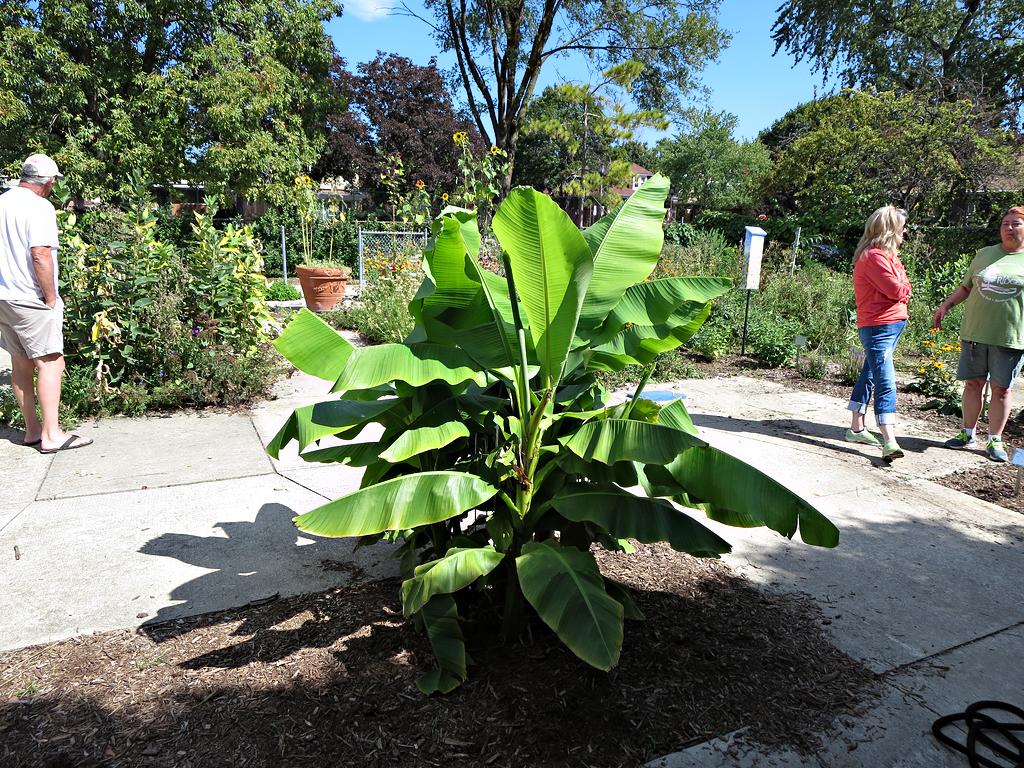 But, I submit that the water sucker on my M. Basjoo is the result of my plant being either genetically or epigentically defective rather than growth practice. Most likely, I was sold a genetically defective runt out of a group of seedlings. This is the second M. Basjoo plant that I purchased and the first was a more vigorous grower. The first survived three years outdoors (zone 5). Sorry, I don't remember where I purchased the plants. I remember that one seller was Stokes Tropicals but I don't remember whether I bought the first or second Basjoo from them. Regarding the possibility that my present plant is epigeneticaly defective, my present plant is a water sucker of a water sucker of a water sucker of a water sucker .... |
Re: Water suckers
|
Re: Water suckers
Here is another example photo I took the other day to show some differences between sword suckers and water suckers. This is the same cultivar, and the shoots are approximately the same age and size. The one on the left is a standard "sword sucker" preferred for direct transplanting in the field, and on the right is more of "water sucker", however, other water suckers can be even more slender with less of a corm than this one has, so maybe it is somewhere else on the spectrum, but closer to a classic "water sucker". As you can see, the corm on the sword sucker is much more developed which suits it better for instantly replanting somewhere else in the ground, whereas the water sucker has a much smaller corm. However, in my experience water suckers really have no disadvantages if they are potted and rooted in the nursery prior to field planting, and I believe the notion that they are inferior planting material comes from the old plantation days when everything was planted from field dug suckers and even holes in the field were filled with suckers from other mats, and because of the lack of modern irrigation practices and the competition between plants, smaller water suckers would no establish and compete as well. However, you only need to look at tissue cultured plantlets to see that they are the ultimate weak and puny water suckers, and with proper care before outplanting, they do just fine and are now industry standard.
As Keith mentioned earlier in this thread, any size sucker can be separated and rooted and grown into healthy plants, they just require proper care. If given the choice, I normally prefer to propagate from the smallest suckers I can find because they are easy to separate and clean, and when you root them in the nursery you have total control over their health from a very young age, and by the time you plant them out in the field they are well rooted and ready to explode in growth. Especially if I am collecting new varieties when traveling, I look for water suckers as they take up so much less bulk during transit.  |
Re: Water suckers
Gabe15, pics do not work.
|
Re: Water suckers
I always let the water pups grow and pulled out the sword pups because they looked different, no wonder I am struggling to get bunches!
|
Re: Water suckers
Snc asked a question as to whether the sword or water suckers (either or both) would reduce the growth of the momma? Does it make a difference if one leaves them to form a patch or transplant? We have like 5 suckers (all sword) on one plant and I would think that as they are all squished together, they would have limited nutrition if left.
|
Re: Water suckers
Snc had a question I have as well - do the suckers, either sword or water, or both, reduce growth of mom? We have one plant with 5 big swords and they are all squished together - seems like nutrition for mom (and swords) would be less if all left together.
|
Re: Water suckers
Quote:
|
Re: Water suckers
Quote:
|
Re: Water suckers
GAbe - great description. Our banana person (has a plantation in Mexico - commercial small scale farming) - looked at our suckers and rejected even the sword suckers based on their relatively small pseudostems at ground level - he will be transplanting them for foliage plants, but says we need to take better care of momma to get "good" swords.w of the water suckers vs sword suckers was pretty much the same in that he was looking at the stem at grorund level and if not big and bulging, was not happy with it. I need to ask again. He is also planting our dug up corms which have dried all winter - he will be chopping off all the pups but not the bulges which are future pups (on the Aroids if we want something really big, we even chop off the "bulges" to limit the number of pjups it puts out.)
|
Re: Water suckers
GAbe - great description. Our banana person (has a plantation in Mexico - commercial small scale farming) - looked at our suckers and rejected even the sword suckers based on their relatively small pseudostems at ground level - he will be transplanting them for foliage plants, but says we need to take better care of momma to get "good" swords.w of the water suckers vs sword suckers was pretty much the same in that he was looking at the stem at ground level and if not big and bulging, was not happy with it. I need to ask again. He is also planting our dug up corms which have dried all winter - he will be chopping off all the pups but not the bulges which are future pups (on the Aroids if we want something really big, we even chop off the "bulges" to limit the number of pups it puts out.)
|
Re: Water suckers
There's a lot of misinformation in this thread. :lurk:
It would have been nice to see one of the junior experts realize this without Gabe having to point this out. Quote:
Quote:
For less experienced growers having "total control over their health from a very young age" could be a bad thing which then leads to all these nonsense posts about water suckers being inferior. If you do not properly care for the water suckers because you believe them to be inferior, then they will not perform well but that is a self-fullfilling prophecy. :woohoonaner: I also prefer to propagate from the smallest suckers I can find and that includes water suckers because they produce larger bunches than large sword suckers. :08: Here's an easy example to understand and you'll see that this small water sucker produced a bunch more than 3 times larger than what the local United States Tropical Research Station averages. This water sucker produced a plant that was shorter than what the research station averages but the pseudostem was more than twice as fat. Most of our bunches are larger than the local research station and that's mainly because they rely on chemical fertilizers and we do not. We rely solely on top mulch for feeding our bananas. A friend sent me this large Dwarf Orinoco sword sucker after I specifically asked for a small sucker. I waited for large sword sucker to produced an offshoot which turned out to be the water sucker with the red arrow pointed at it and that is the banana I grew. I removed all of the following suckers and when it was developed enough the mother plant was removed. Quote:
Quote:
Quote:
Quote:
|
Re: Water suckers
Keith, do you directly plant in the field any of the suckers you harvest right after removing them? Or do you pot them up and grow them out for a while before transplanting to the field?
|
Re: Water suckers
Quote:
Here is a photo of a couple variegated Manini nubs/seeds, their health is dependent upon receiving proper care not on where they are planted. They can do just as well planted directly in the field as they can do in a pot. |
Re: Water suckers
Quote:
|
Re: Water suckers
Thanks for posting the photos of the water and sword suckers! I have one growing fast, but I now know that its a water sucker. It has some beautiful leaves right out of the ground. Darn! I will remove it tomorrow.
:0519: |
Re: Water suckers
Thank you for this thread, I had the same question and this sorted my mind out!
|
| All times are GMT -5. The time now is 10:57 AM. |
Powered by vBulletin Version 3.6.8,
Copyright ©2000 - 2026, Jelsoft Enterprises Limited.
All content © Bananas.org & the respective author.