
|
Musa itinerans article has been published! At least 6 varieties.
I have the new Musa itinerans article, written by Markku Hakkinen and published by Novon (Hakkinen, Markku. "Musa itinerans (Musaceae) and Its Intraspecific Taxa in China." Novon 18 (2008): 50-60.).
Here are the 6 varieties described in the article: Musa itinerans var. itinerans Musa itinerans var. annamica (formerly Musa itinerans subsp. annamica) Musa itinerans var. chinensis Musa itinerans var. guangdongensis - Not 'Burmese Blue' Musa itinerans var. lechangensis Musa itinerans var. xishuangbannensis The big news here is that variety guangdongensis is not synonymous with 'Burmese Blue'! 'Burmese Blue' looks to be another variety of M. itinerans, but isn't covered in the article. Neither is Musa formosana of Taiwan. In fact, the article states that "Several other Musa itinerans varieties can be observed in Hainan, Taiwan, Vietnam, Thailand, Laos, Myanmar, and India, but these taxa are subject to further study." I immediately looked for The 'Yunnan' variety, and it looks to be var. chinensis. Only var. itinerans and var. xishuangbannaensis have the very long rhizomes. Var. annamica is rhizomatous as well, but has short rhizomes (0.2-0.5m away from parent plant). How's this for a biggun: var. xishuangbannaensis has a female bud of size 80 cm x 20 cm (that's 2 1/2 feet long)! The pseudostem is second only in size to Musa ingens, at 12 m (almost 40 ft.) tall (Musa ingens is 15 m (almost 50 ft.) tall). It sends rhizomes up to 5 m away from the parent plant. Leaf size = 500 x 105 cm ... now my math isn't that good, but isn't that 5 meters x 1.05 meters?? A 15 + foot leaf? WOW!! I somehow have the feeling now that the banana in my gallery is not var. xishuangbannaensis! Or it could just be really small? LOL. I'm having a hard time wrapping my brain around a 15+ foot leaf... I could go on and on with this article, but that would take awhile. I really wanted to compare the Musa yunnanensis description with Musa itinerans var. chinensis. The descriptions are similar, but there are definite differences. I haven't become an "expert" on deciphering botanical language, so I'm still learning that. The biggest obstacle I have is that the flowers and fruit are the most easily-distinguishable differences, and I don't get flowers or fruit here! I am forced to go by pictures, and that gives me a little bit better of an idea. I still want to see the plants side by side, as Markku says that they are easily distinguishable in the field vegetatively. Anyhow, here are some of the major differences: M. yunnanensis male flower bud is lanceolate (12 x 4 cm), whereas Musa itinerans male bud is ovoid (15 x 9 cm). M. yunnanensis male bud has a yellow apex, M. itinerans does not (or at least it isn't specified in the description). M. yunnanensis has a very waxy stem with black blotches even close to flowering size, M. itinerans does not (although it does have some wax). M itinerans always has a reddish color when young, Musa yunnanensis does not. Sap is watery with M. yunannensis, watery-milky with M. itinerans. Both species have rounded and auriculate leaf bases, although Musa itinerans leaf bases are asymmetric, where Musa yunnanensis has symmetric leaf bases. There is a difference in the fruits also. Inside, Musa itinerans has ovules in 4 rows per locule. Musa yunnanensis has ovules in 2 rows per locule. So, Musa itinerans has about 250-270 seeds per fruit, and M. yunnanensis has 80-100 seeds per fruit. Musa itinerans also has basal female flowers, where Musa yunnanensis has basal hermaphrodite flowers. The only Musa itinerans variety (described in this article) to have hermaphrodite flowers is var. xishuangbannaensis. I could go on and on with the similarities. Maybe Eric will read this and check out the fruit. Eric, email me if you read this please. |
Re: Musa itinerans article has been published! At least 6 varieties.
What does Agristarts sell(sold), yunannensis?
I think that is what I have. |
Re: Musa itinerans article has been published! At least 6 varieties.
Quote:
Also, Musa itinerans 'India Form' was not described in this article, so it must be one of the varieties that Hakkinen alluded to that needs future study! I'm just speculating that though. Another distinguishing feature of var. xishuangbannaensis is that the sap is watery red. I'm thinking that the variety that I have is var. itinerans, but can't know until spring (if it returns, that is). A very promising part of the article states that each of these varieties is subject to frost and snow in at least part of its natural range. That means that they should all be somewhat cold-hardy! |
Re: Musa itinerans article has been published! At least 6 varieties.
could you send me a copy?
|
Re: Musa itinerans article has been published! At least 6 varieties.
It's a copyright issue, so unfortunately no I can't. It should be printed on a website somewhere soon though. The Musa yunnanensis description was.
|
Re: Musa itinerans article has been published! At least 6 varieties.
Hey Frank, a 15' leaf is big, but Musa 'Balboa' gets a 12' leaf which is awfully close. Of course, good luck with any of us in Tennessee getting a leaf that big.
|
Re: Musa itinerans article has been published! At least 6 varieties.
Yeah, but is that 12' with the petiole? The petioles on var. xishuangbannaensis are about 100 cm long, which amounts to another 3 1/2 feet! So they are close to 20 feet long total. But you're right...good luck with any of us ever seeing that here in TN!
|
Re: Musa itinerans article has been published! At least 6 varieties.
Ahh...that 12' included the petiole.That means that x$%#&*$%&% (sorry about the spelling) is actually a good 50% longer than 'Balboa', which is really huge.
|
Re: Musa itinerans article has been published! At least 6 varieties.
I checked and the ones we have has just clear watery sap, I sawed one off yesterday. So you think it is just var. itinerans not var. xish. ? The stalk that was flowering hasn't set any fruit yet. There is another getting ready to flower, the bud is just emerging but it isn't any larger than the first.
So is the Musa sp. "Yunnan" M. yunnanensis or M. itinerans var. chinensis? Here is the photo of the rhizome of the Musa itinerans we have (itinerans or xish.?). It was about 4ft from the parent, the rhizome itself has a nice red color but no red sap. 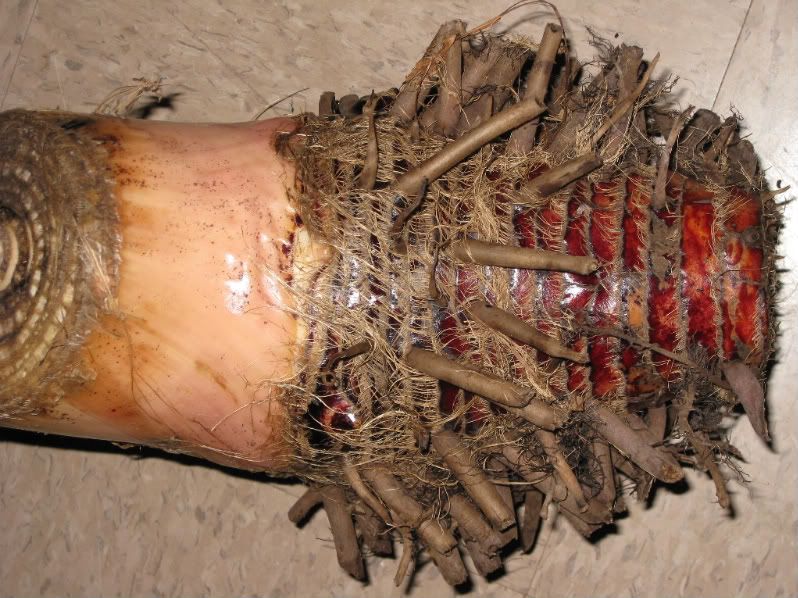 |
Re: Musa itinerans article has been published! At least 6 varieties.
What happened to Musa Itinerans var. "formasana"? Is that one back to Musa basjoo var. "formasana" or a new distinct species?
Erlend |
Re: Musa itinerans article has been published! At least 6 varieties.
Quote:
|
Re: Musa itinerans article has been published! At least 6 varieties.
Quote:
The other banana is Musa yunnanensis. There is a big difference in the shape of the flower bud between it and M. itinerans. Nothing about M. formosana or M. 'Burmese Blue' was addressed in this article. |
Re: Musa itinerans article has been published! At least 6 varieties.
Hi,
wow, these 6 are even the must for my yard in Brazil! Are still there seed stores which are still offering seeds of these species and varieties and will also ship to Brazil? 12 metres is very much! This will be one sensation in Brazil, the second largest! Thanks in advance. Best wishes Basjoofriend |
Re: Musa itinerans article has been published! At least 6 varieties.
Frank, I just found this thread. Sorry to duplicate it in my post. Guess I should have searched first, I was just too excited.
Good info on itinerans forms. I will keep my fingers crossed that what i have is in fact, Xishuangbannensis. Can't wait to see red sap! Then we will know for certain. |
| All times are GMT -5. The time now is 05:07 PM. |
Powered by vBulletin Version 3.6.8,
Copyright ©2000 - 2026, Jelsoft Enterprises Limited.
All content © Bananas.org & the respective author.