Here's a final rundown on how it went with the Physalis (ground cherries) I grew this year. I'd never grown any of these before and they are pretty wonderful, really. I grew two different varieties of Physalis peruviana (aka Cape Gooseberry, Poha, Golden Berry) and one variety of Physalis pruinosa (Aunt Molly's Ground Cherry).
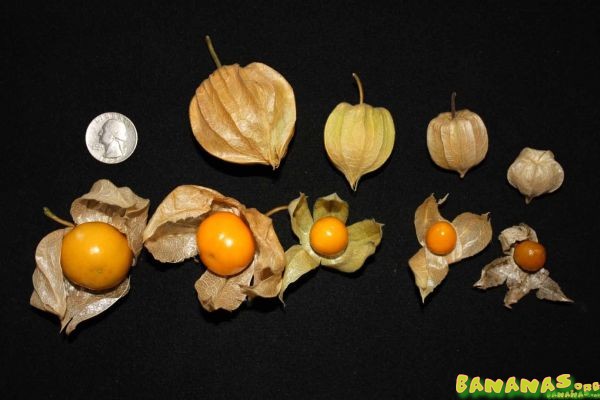
From left to right: two P. peruviana from seeds from Harvey, two P. peruviana from Trade Winds seeds, and one P. pruinosa (Aunt Molly's).
[IMG]
[/IMG]
left: P. peruviana from Harvey; right: P. peruviana from Trade Winds
[IMG]

[/IMG]
In my 10'-long raised bed, on left P. peruviana from Trade Winds and on right P. peruviana from Harvey.
[IMG]

[/IMG]
This photo was taken a few months ago, and these plants are now quite a bit bigger. The one on the left has about an 8' diameter now.
P. peruviana is a great plant. It seems immune to all the fungal diseases that make growing tomatoes in my cool, humid, coastal environment a pain in the neck. They don't seem to need any special care, except keeping an eye out for potato beetles and hornworms, both of which absolutely love them. The fruit have their own wrappers and are really tasty. I shared them with lots of my friends and have yet to find anyone who doesn't like them. They have a unique flavor with a nice combination of sweet and tart. My wife, who is picky, loves them.
Though the leaves and fruit are larger on the plants from the seeds that Harvey sent me than on the plants from the Trade Winds seeds, I don't detect any difference in the flavor. The bigger fruit on the "Harvey plants" are a plus, but they were a bit slower to produce than the Trade Winds plants and produced fewer fruit (though probably the same weight of fruit per plant). I'd prefer to have more but smaller fruit, so I'd probably choose the Trade Winds variety, but they are both great, and very similar.
The plants in my raised bed were slower to produce than the potted ones, I'm guessing because of lower soil temperatures, but they are much bigger, more productive, and produce bigger fruit on average. In the photo of the fruit, for the paired fruits of the same variety, the ones on the right are from potted plants. The two potted plants I have are in 5 and 7 gallon containers, and that is too small. I'd say 15 gallons is a minimum -- unless you want to water every day and fertilize a lot. I had to water pretty much every day or every other day during the middle of summer -- and that's in a cool, moist environment.
The Physalis pruinosa I grew didn't work out for me. This species was a pretty fast grower compared to P. peruviana, but was susceptible to some fungal disease that did it in (all 4 plants), and frankly, I didn't really like the flavor. It had a cheesy, slightly bitter taste on top of a more normal fruit flavor. And the fruit were small and tended to drop before getting ripe.
Next year I'll grow at least a few Physalis peruviana plants and I'm going to try Physalis pubescens, based on some rave reviews by Planetrj. But who knows, maybe the plants I still have going now will make it through winter and I won't have to start new ones. They were all easy to start from seeds, so don't pay the outrageous prices I've seen at nurseries near me for potted plants ($29-$46 for a plant in a 3-5 gallon pot). But keep in mind, they are slow to start producing fruit -- much slower that tomatoes.